
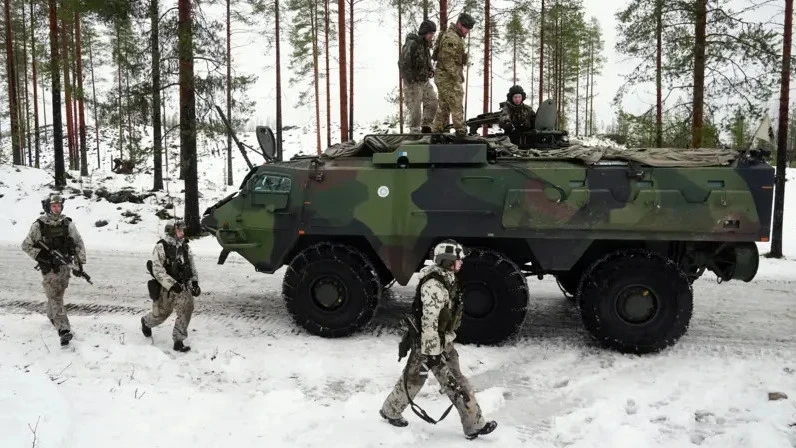
Finnish and British military during exercises near Kajaani, December 2025
According to the current legislation of Finland, adopted in 1987, any actions related to nuclear warheads, including their import and storage, are prohibited even in wartime. However, Finnish Defense Minister Antti Häkkänen stated that the security situation in Europe and Finland has "fundamentally changed" since the beginning of Russia's full-scale invasion of Ukraine in 2022. In this context, in 2023, Finland, which shares a border with Russia, ended its military neutrality and joined NATO.
The government has proposed amendments to the law that would allow "the import of nuclear weapons into Finland, as well as their transportation and storage in the country, if related to military defense." According to Häkkänen, such an amendment is necessary to ensure Finland's military security within the alliance and to utilize NATO's collective defense capabilities.
The principle of collective defense, which is the foundation of NATO, implies that an attack on one of the alliance's members is considered a threat to all. This is also the basis for nuclear deterrence that exists within the organization.
Since NATO includes nuclear powers, an attack on one of the member countries could lead to a nuclear response. The Center for Arms Control and Non-Proliferation reports that American nuclear weapons are deployed in several European countries.
To implement the proposed government changes, amendments to the nuclear energy law and the criminal code are required. As reported by the parliamentary ruling coalition, public discussions of the draft will last until April 2, after which it will be presented to parliament.
Finland, which has the longest border with Russia among European countries (1340 km), became the 31st member of NATO in April 2023 following the Russian invasion of Ukraine. Sweden, a neighboring country, also joined NATO in 2024. The eastward expansion of the alliance has been repeatedly criticized by Russian President Vladimir Putin, and many experts view this as a strategic defeat for him.
Last week, Swedish Prime Minister Ulf Kristersson stated that the doctrine prohibiting the deployment of foreign troops and nuclear weapons in the country "will not apply" if Sweden finds itself in a "completely different situation."
On Monday, France and Germany announced their intention to deepen cooperation in nuclear deterrence with European partners. The Kremlin, in turn, warned of possible retaliatory measures in the event of nuclear weapons being deployed in Finland. Russian President's spokesman Dmitry Peskov stated: "These statements lead to an escalation of tension on the European continent and create risks for Finland. If Finland begins to threaten us, we will be forced to take retaliatory measures."


