
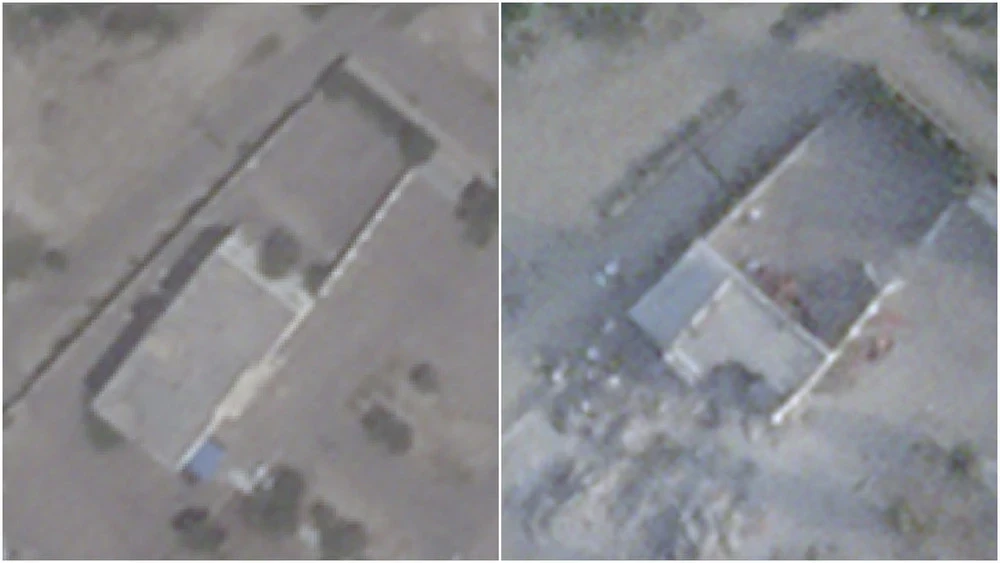
Satellite images show the scale of destruction. On the left, the school on May 24, 2024, and on the right, May 4, 2026
The strike on the school in Minab became one of the most tragic incidents involving civilian casualties since the beginning of US and Israeli attacks on Iran. So far, neither side has claimed responsibility for what happened.
Analysis conducted by The New York Times, based on satellite images, social media posts, and verified videos, indicates that the school was significantly damaged as a result of a targeted strike that coincided with an attack on the IRGC naval base.
Official reports mentioned actions by US forces against maritime targets in the Strait of Hormuz, which may suggest possible US involvement in this incident.
White House Press Secretary Caroline Levitt, responding to a request from The New York Times, stated that to their knowledge, the US did not strike the school, adding that the Department of Defense is conducting an investigation.
Establishing the exact circumstances of the strike is difficult, as there are no weapon fragments, and foreign journalists do not have access to the site. Iranian authorities and state media report 175 fatalities, including many children, but independent sources have not yet confirmed this data.
For several days after the incident, US authorities did not comment on their possible responsibility. US Secretary of Defense Pete Hegseth confirmed that an investigation is currently underway. Israeli military officials confirmed that they were unaware of their operations in the area at the time of the strike.
However, US representatives mentioned that aviation was conducting operations in the region where the school is located that day.
The elementary school is located in the small town of Minab in southern Iran, more than 600 miles from Tehran, near the strategically important Strait of Hormuz. At the time of the strike, which occurred on Saturday, children and teachers were in class.
Initial reports of the attack appeared on social media shortly after 11:30 local time. Analysis of these posts and eyewitness videos indicates that the school was struck simultaneously with the naval base. One video, identified through geolocation, shows large columns of smoke rising from the area of both sites.
Photographs of the destruction of the school building were disseminated by an Iranian human rights organization. Videos published by Iranian media and verified by The New York Times show people sifting through the rubble in search of survivors.
A video was also recorded by a driver passing by the IRGC base, showing entrances with IRGC emblems and signs for the naval medical command.
The New York Times analysis showed that thick smoke columns were rising above the site of the strikes on military buildings.
To better understand the extent of the damage and the reasons for the strike, The New York Times commissioned new satellite images from Planet Labs. An image taken on Wednesday confirmed the sequence of events.
Satellite images showed that several targeted strikes hit six IRGC buildings and the school. Four buildings at the base were completely destroyed, and two others showed roof damage typical of precision strikes.
Wes J. Bryant, a national security analyst and former US Air Force officer, noted after analyzing the new satellite images that all buildings, including the school, were subjected to "virtually perfect targeted strikes."
He suggested that a likely cause of the incident could be "target misidentification," where the military attacked a site without realizing that civilians might be inside.
At a press conference on Wednesday, Chairman of the Joint Chiefs of Staff General Dan Keen stated that at the time of the strike, US forces were attacking southern regions of Iran. He presented a map showing that the area, including Minab, was among the targets of the attack, although the city itself was not directly mentioned.
General Keen also noted that Israeli forces were primarily operating in the north and provided several examples of US operations against targets in southern and southeastern Iran, without mentioning the presence of Israeli forces.
He added that the USS Abraham Lincoln carrier strike group is exerting pressure on Iran's naval capabilities along the southern coast.
Satellite images from 2013 show that the school building was once part of the IRGC base, and roads from its territory led directly to the school. However, by September 2016, the area had been separated, and the school no longer had any connection to the base.
Historical satellite images also confirm that the building exhibited signs of an educational institution, including sports fields and recreational areas that developed over time.
Bet Van Shaak, a former US State Department official and now a lecturer at Stanford University, noted that given the US intelligence capabilities, they should have been aware of the presence of a school in close proximity.
There have also been speculations online that the cause of the strike could have been an Iranian missile that went off course. However, The New York Times and other analysts dismissed this version, pointing out that a single missile could not cause such precise damage to multiple buildings simultaneously.
Currently, US authorities continue their investigation. If it is determined that a US bomb struck the Shajarah Tayyebeh school, key questions will include whether this was a mistake or if the target was attacked based on outdated intelligence.
International humanitarian law expert Janina Dill noted that parties to the conflict are obligated to verify the status of targets before an attack to eliminate the risk to civilians, and failure to comply with this rule may be considered a violation of international law.


