
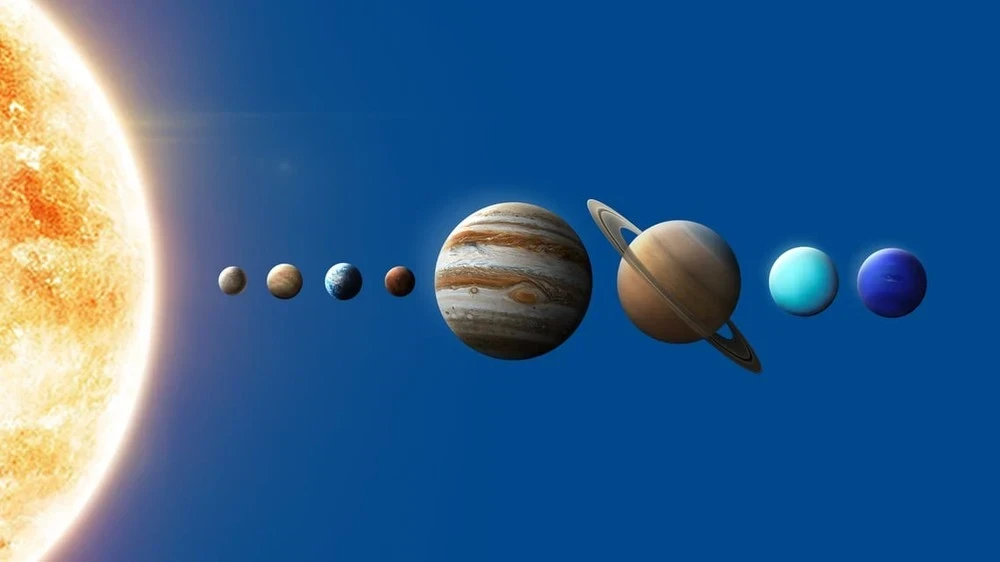
This astronomical event can be observed not only on the 28th but also a day or two before and after. During this time, Mercury, Venus, Jupiter, Saturn, Uranus, and Neptune will be in one sector relative to Earth. This effect is achieved because the orbits of the planets are located in the same plane, known as the ecliptic plane. Although in reality they do not line up perfectly in space, they will appear to do so to an observer on Earth.
The best time for observation is about half an hour to an hour after sunset, and one should look to the west. Mercury, Venus, Jupiter, and Saturn are visible to the naked eye. Venus will be the brightest of all, while Jupiter will be positioned higher and to the southeast. Saturn will be faintly visible and will be closer to Venus, low on the horizon. Mercury will be harder to see, as it will only appear for a short time after sunset.
To see Uranus and Neptune, a telescope or at least binoculars will be needed.
This year promises to be rich in astronomical events: on April 18, a small morning parade of Mercury, Mars, Saturn, and Neptune is expected; on June 12, a mini-parade featuring Mercury, Venus, and Jupiter will take place; and on August 12, another big parade will occur—during the morning hours, Mercury, Mars, Jupiter, Saturn, and Neptune will be visible. Finally, on November 14, Mercury, Venus, Mars, and Jupiter will line up in the morning.


