
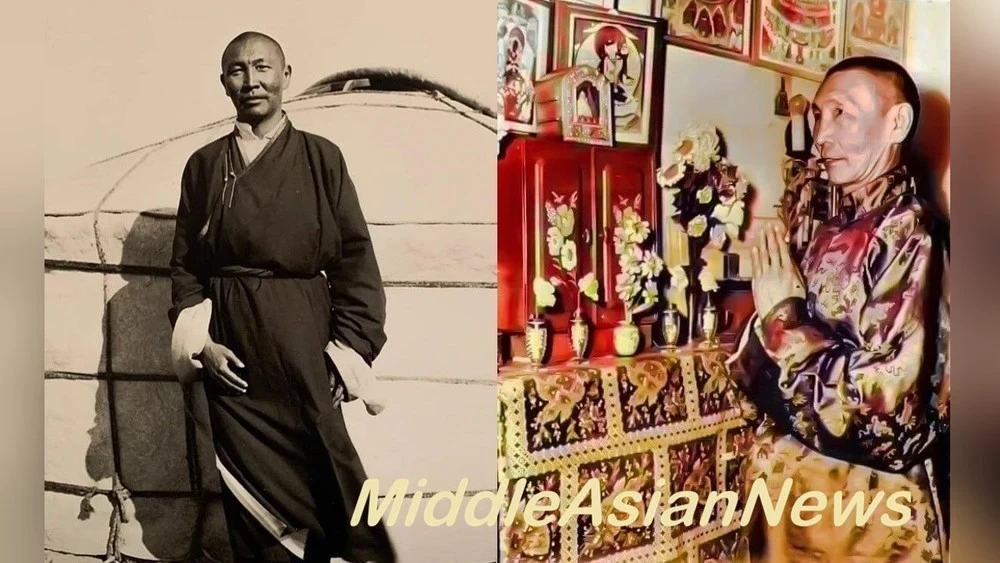
Dilav Khutagt (Telo-tulku) Jamsranjav Bashluu
At a recent government meeting, it was decided to publish 1039 pages out of 1133 documents related to Dilav Khutagt (Telo-tulku) Jamsranjav Bashluu, stored in the Special Archive of the Main Intelligence Directorate. Also, 1039 pages of documents that do not fall under the Law on State and Official Secrets will be disclosed, the Public Relations Office of the government reported. This was informed by MiddleAsianNews.
Established in 1922 as the Department of Internal Security, this institution conducted numerous intelligence operations aimed at maintaining the independence and security of the state, among which the most significant was the secret operation to export Dilav Khutagt Jamsranjav Bashluu abroad.
The new generation intelligence agency of Mongolia created a spy legend for him. According to this legend, Jamsranjav was a respected Buddhist figure and an influential monk, making him a trusted person for Banchin-Bogdo (Panchen Lama). The high-ranking monk was arrested in the case of "Eregdendagva 38", his livestock was confiscated, and he was later released with a two-year suspended sentence. In 1928, he submitted a request to the Department of Internal Security for permission to travel to Banchin-Bogdo, but the problems and delays that arose led to the development of a plan for his "escape" from Mongolia. In February 1931, Dilav Khutagt successfully crossed the border. He was later declared "fugitive" after being convicted in the case of "Eregdendagva 38" among other refugees from Mongolia and Inner Mongolia. Initially, this was just a cover, but over time it turned into the real life of a fugitive.
For six years, Dilav Khutagt Jamsranjav Bashluu worked as an advisor to Chiang Kai-shek and collaborated with the famous American scholar Owen Lattimore, which significantly contributed to the recognition of Mongolia's independence by the Kuomintang. When Lattimore visited Mongolia, he noted: "Dilav Khutagt is the one who had a significant influence on the recognition of Mongolia's independence by China. This needs to be properly understood."
Jamsranjav Bashluu (Mong. Bashluugiin Jamsranjav; October 8, 1884, Zasagt Khan Aimag (now Zavkhan Aimag) — April 7, 1965, New York) — Telo-tulku (Mong. Dilova Khutagt) XI (V), a Mongolian religious and political figure, as well as a Mongolist.
There was an opinion that on February 26, 1931, fearing for his life, Dilav Khutagt left the Mongolian Republic and went to Inner Mongolia, which subsequently led to his derogatory nickname of traitor and fugitive. In Inner Mongolia, hiding under the names "Lieutenant Jamsran" and "Gun," he interacted with the regimes of Chiang Kai-shek and the pro-Japanese regime of Mengjiang in Devan, as well as met with the Panchen Lama and the young 14th Dalai Lama during his three-year stay in Tibet. He also participated in the election of the ninth Bogdo Gegene to the post of Khubilgan.
In 1950, American orientalist O. Lattimore suggested that Jamsranjav emigrate to the USA, where he began to give lectures on Mongolian studies at the University of Baltimore. He became the Hambo Lama of the Nitsan temple, built with funds from the Kalmyk community in New Jersey. In 1960, Jamsranjav participated in a session of the UN General Assembly, which contributed to the inclusion of the Mongolian Republic in the Organization, based on the Declaration on the Granting of Independence to Former Colonies, playing an important role in changing Chiang Kai-shek's opinion, who previously considered this country part of the Republic of China.
Jamsranjav passed away on April 7, 1965, in New York. His successor as Dilova Khutagt was the Kalmyk of American origin E. B. Ombadikov, who was later elected Shadzhin Lama of Kalmykia.


