
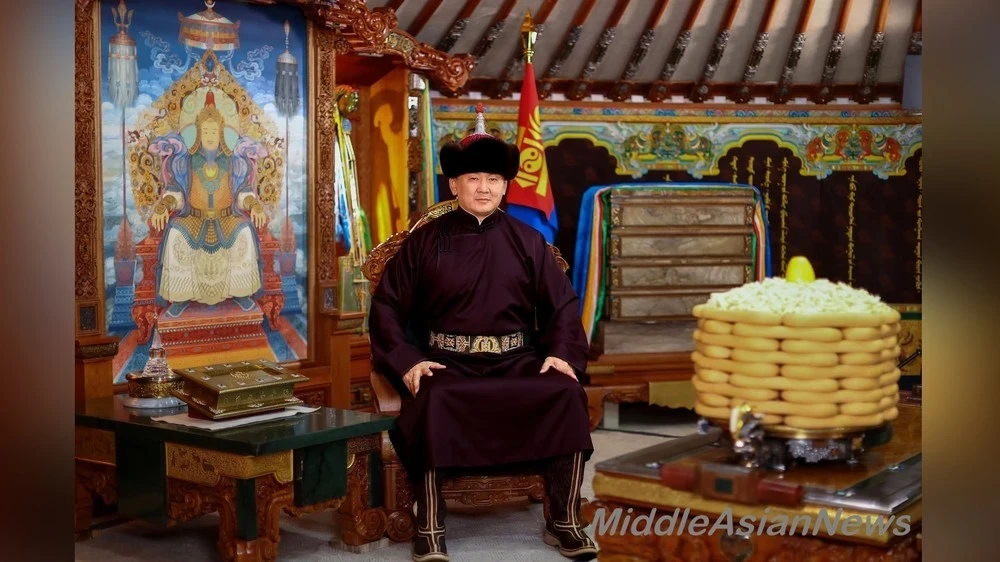
President of Mongolia Khurelsukh Ukhna
The celebration of the Mongolian New Year — Tsagaan Sar will take place from February 18 to 20, 2026, as reported by MiddleAsianNews.
Tsagaan Sar, which translates to "white month," is an important family holiday celebrated by all Mongolians according to the lunar calendar. Since the date of the celebration depends on the first day of the spring lunar month, it shifts each year. Modern traditions involve a three-day celebration, although some rituals may last longer.
According to the Mongolian calendar Togos-Buyant, the date of the holiday can vary each year. Astrologers calculate the date of Tsagaan Sar based on the position of the moon in the zodiac.
Astrologers from the Gandan Tegchenling Monastery assert that the most accurate astrology system for Mongolia is Togos Buyant, developed in the 18th century by renowned lama-astrologers. This system takes into account the climatic conditions of Mongolia, which is why the New Year celebrations do not coincide with those of the East. Eastern astrology, in turn, is based on the warmer climatic conditions of China.
The Tsagaan Sar ceremony has its roots in the era of the Huns-Mongols and has been preserved over the centuries as an important holiday among the Mongolian peoples. This event holds great significance, as there are not many holidays in the Mongolian calendar, and Tsagaan Sar is practically the only nationwide holiday. In the 20th century, the tradition underwent changes due to historical events in Russia and Mongolia, such as revolutions. Religious persecutions during the Soviet period also affected the celebration, and Buddhist elements gradually disappeared. Nevertheless, the holiday was legalized in 1960 and began to be perceived as a popular celebration honoring veterans and the achievements of the country.
Before the start of Tsagaan Sar, thorough cleaning is carried out in homes. On the eve of the holiday, families bid farewell to the departing year in a ritual called "bituuleg." It is important to settle all debts and mend relationships with those with whom there were conflicts. For this purpose, "khöörög" — snuff boxes with snuff tobacco — are exchanged, symbolizing forgiveness. It is essential to enter the new year with a pure heart, leaving negativity behind.
The celebration begins on the last day of the old year, called "bituun," which translates to "closed." On this day, Mongolians must stay at home, eating traditional dishes such as buuz and dumplings. There is a belief that people over the age of 13 should not sleep on this day, as the Buddhist goddess Lham may consider a sleeping person to be dead. On New Year's Eve, families gather around the festive table to bid farewell to the old year and welcome the new one. Various dishes are prepared, including a fat ram and dairy treats. The tradition of the feast has its peculiarities: elders occupy the honorific places, the youth sit on the right side, and women on the left.
On "bituun," it is also customary to hang three transparent ice pieces over the door of the yurt — this is considered a drink for the goddess's steed, and to leave thorns on the left lintel to protect the home from evil spirits. On the last day of the old year, many Mongolians visit Buddhist monasteries for purification from sins and to pray in farewell to the departing year.
According to traditions, the meeting of the new year begins not at midnight but with the sunrise on the first day of the new year. On this day, all family members wear new clothes and begin to congratulate the elders, followed by the neighbors. Spouses, according to custom, do not exchange greetings, as they are considered one whole.
President of Mongolia Khurelsukh Ukhna congratulated the people on the holiday of Tsagaan Sar.
In his address, the head of state shared the following words:
“Dear fellow citizens,
My brothers and sisters,
I congratulate you on Tsagaan Sar, the Year of the Fire Horse, which is celebrated in the 17th year (in the Mongolian calendar, this term is analogous to the concept of "century").
Tsagaan Sar has a long history dating back to the times of the Hunnu dynasty and symbolizes our spiritual independence, as well as being an important source of our history, culture, and traditions.
During this great holiday, we Mongolians traditionally pray to the heavens and show respect to our elders, study our genealogy, and observe etiquette, paying attention to kindness and striving for peace.
We must preserve and pass on our traditions, culture, and values from generation to generation, as well as to future descendants.
The Great Bogd Chinggis Khan is a symbol of the Mongolian people and our history.
We must honor and spread the glory and wisdom of the Great Khan, who is the guardian of our empire.
In this regard, a decree has been issued to restore the ancient capital of Kharkhorum, preserve cultural heritage, and create a new 30-volume history of Mongolia.
The United Nations General Assembly supported the initiative to establish a "World Horse Day," which will become a symbol of pride for the Mongolian people, and plans are underway to create a museum dedicated to the Great Khan, as well as other monuments.
Thus, the international community begins to celebrate this day as our national holiday.
The Year of the Fire Horse also marks the 820th anniversary of the founding of the Great Mongolian Empire by Chinggis Khan.
In connection with this anniversary, a decree has been issued to confer the title of "Chinggis Khan" and the status of the state sacred mountain Black Heart.
We are pleased to announce that Lake Khubsugul, which has been a source of life and fresh water in Central Asia for centuries, has been declared a state sacred site.
For Mongolia, this is the first case where we have a national sacred lake.
The Year of the Horse, symbolizing the great ruler Chinggis Khan, has always brought blessings and strength to the people.
In the upcoming Year of the Fire Horse, let us develop our country together, value peace and justice.
May the spirit of the Mongolian people shine like fire, and may there be peace throughout the world.
I congratulate everyone on the upcoming Tsagaan Sar, wishing happiness and blessings to my people and all Mongolians around the world.
May Mongolia thrive under the protection of the Eternal Blue Sky!”


