
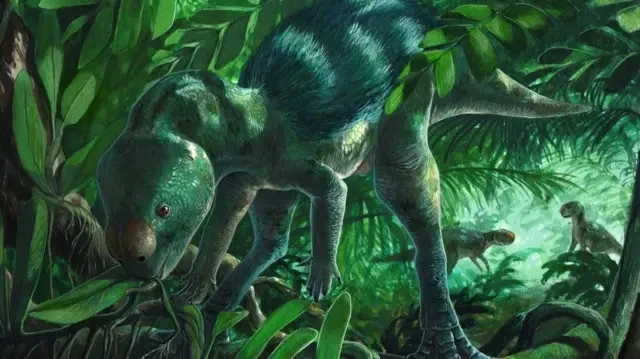
As a result of long research, scientists have identified a new species as Foskeia pelendonum. According to them, this dinosaur lived on the planet about 125 million years ago and belonged to the ornithopods, an extinct group of herbivorous dinosaurs. Despite its small size, its skull turned out to be quite a complex anatomical structure.
“The anatomy of this dinosaur is so unusual that it forces us to reconsider evolutionary trees,” noted paleontologist Penelope Cruzado-Caballero from the University of La Laguna in Spain.
The research on the find was conducted by an international group led by paleontologist Paul-Emile Dieudonné from the National University of Río Negro in Argentina. The scientists established that the discovered remains belong to at least five different individuals.
“The most interesting aspect of this discovery is that, apparently, there are many more similar fossils, and most of them will be small dinosaurs,” Dieudonné told the BBC in an interview.
“Small dinosaurs were much more diverse than we thought, and perhaps many known groups originated from them, increasing in size over time,” he added.
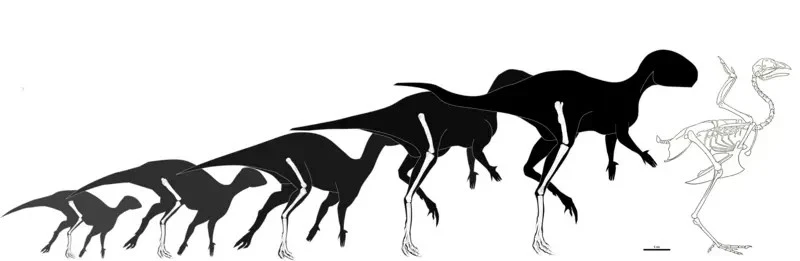
Foskeia pelendonum is comparable in size to a chicken
The smallest dinosaur in Europe
However, as Dieudonné noted, the bones of small dinosaurs are more fragile, making them harder to detect. “Unfortunately, small fragments are much more destroyed, and the structure of some bones quickly disappears,” he added.
According to paleontologist Cohen Stein from the Free University of Brussels, this dinosaur stands out among the found remains in Europe due to its miniature size.
The height of Foskeia is estimated to be about 25-30 cm, comparable to the size of a chicken.
“It can be confidently said that this is one of the smallest, if not the smallest dinosaur in Europe and possibly in the world,” Stein stated in an interview with the BBC.
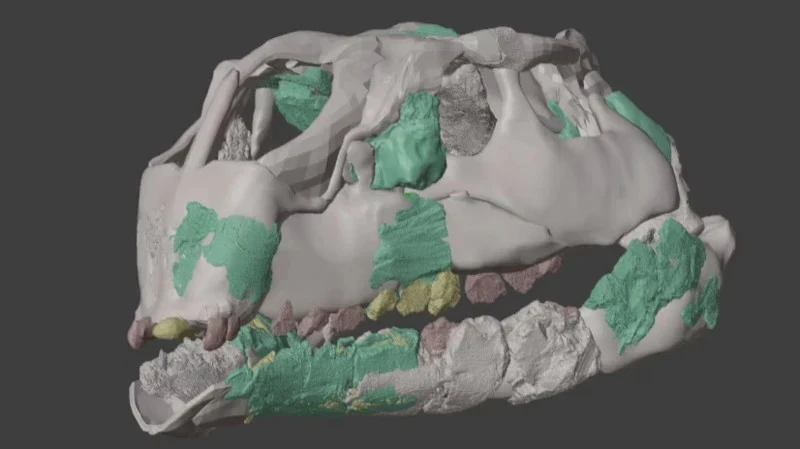
Researchers created a 3D model of the small dinosaur's skull
Initially, scientists believed that the small bones belonged to young individuals. However, more detailed studies showed that at least one of the discovered dinosaurs was an adult. According to Stein, at a young age, they likely moved on four legs, while in adulthood, they transitioned to bipedal walking.
Foskeia is considered the earliest representative of rabdodontomorphs — a group within ornithopods.
Research shows that rabdodontomorphs “may have been very small from the very beginning,” which allowed them to avoid predators, Dieudonné explained. “Although small size does not contribute to fast running over long distances, it is perfect for rapid hiding,” he added.
A long path to discovery
Most of the fossils were found back in 1998, and subsequent finds were made in the following years at the same location. However, their identification took decades.
The initial discovery of this site and the collection of the main part of the remains belongs to Fidel Torsida Fernández-Baldor — one of the co-authors of the study from the Dinosaur Museum in Salas de los Infantes in northern Spain.
“From the very beginning, we realized that these bones were unique due to their tiny size,” Torsida Fernández-Baldor stated.
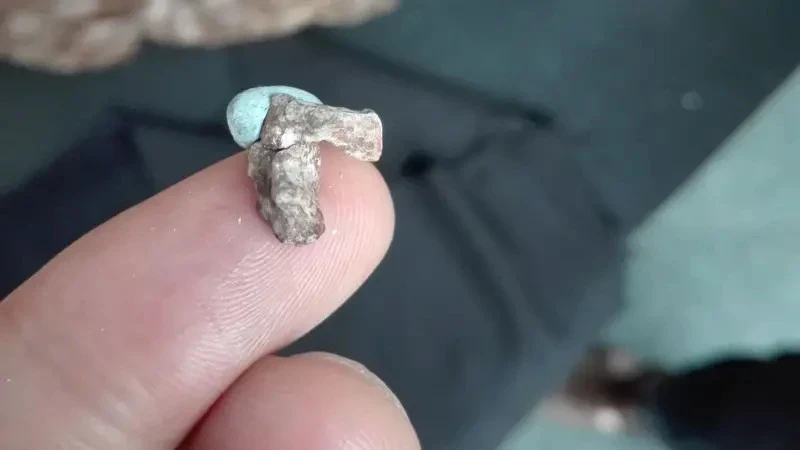
In the new study, articulated bones (bones connected at a joint) from the skull roof and braincase of Foskeia pelendonum were analyzed
The discovery of Foskeia — the name comes from the ancient Greek word for “light” — helps expand the understanding of the evolution of ornithopod dinosaurs. “Miniature size does not indicate primitiveness,” emphasizes co-author of the study, paleontologist Marcos Becerra from the National University of Córdoba in Argentina.
Foskeia also has an unusual arrangement of teeth: the front teeth are positioned forward and look “like a huge trident,” according to Dieudonné. The dinosaur also exhibits “interesting skull morphology,” Stein added.
“This is yet another example of experiments conducted by evolution,” he concluded.
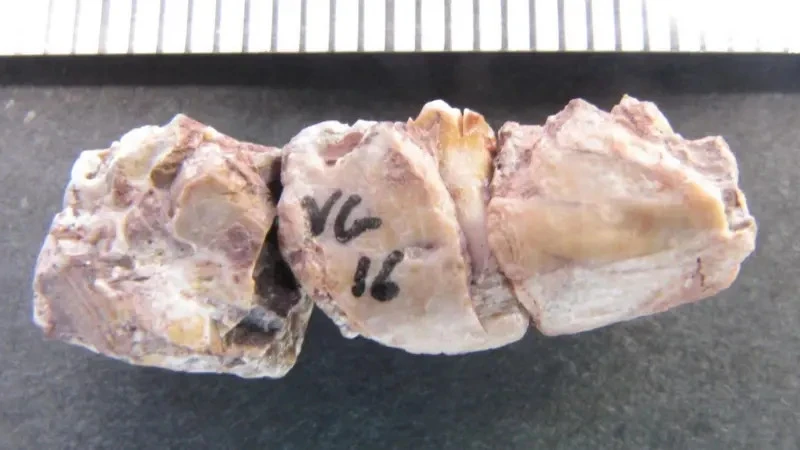
A fragment of the dental bone (lower jaw) of Foskeia pelendonum
The significance of the skull
Previously, in 2016, these fossils were preliminarily attributed to an ornithopod-type dinosaur called Vegagete. However, at that time, the lack of data did not allow for an official description and classification.
The new breakthrough occurred thanks to the discovery of additional skull elements, which allowed for the definitive identification of the dinosaur as Foskeia pelendonum.
“The skull generally provides the most information about living beings,” Dieudonné explains. “It informs about the chewing process, vision, and body balance.” According to him, the shape of the head adapts to the needs of the animal in its environment, and “even small and fragmented skull bones can tell a lot about its lifestyle.”
“Documenting such finds is important for understanding the growth, lifestyle, death, and evolution of these beings, which helps us better realize how life on Earth has changed,” the scientist added.


