
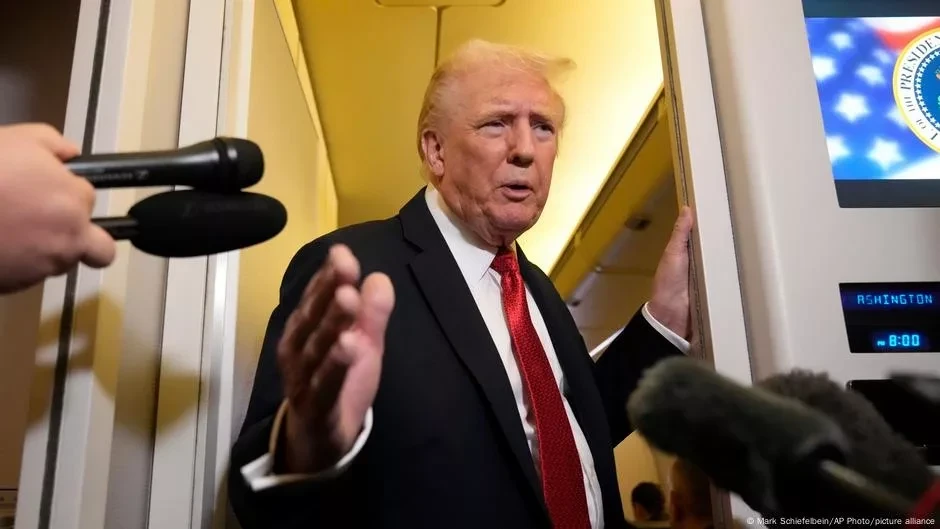
According to the authors, Trump has become a central figure undermining the foundations of international relations, leaving Europe without the necessary protection from the United States. The issue of the course of Russia's war against Ukraine has also not gone unnoticed by the authors of the report, who note: "Destruction is underway." The symbol on the cover—a elephant representing the Republican Party of the USA—highlights Trump's destructive policies.
What will be the next steps in American-European relations after Trump's recent speech in Davos and the crisis surrounding Greenland? This question is likely to become a key topic at the upcoming forum in Munich, which will take place on February 13 and gather many world leaders.
America is no longer a reliable partner for Europe
The Munich Security Conference, which has existed for over 60 years, has begun to release reports in recent years. This has been the result of an initiative by its long-time chairman, Wolfgang Ischinger. The 2026 report is one of the bleakest in recent times. In his opening remarks, Ischinger points out that while previously US allies could rely on "American strength" and shared principles, this now seems "significantly less" reliable. The report states that the "era" when Europe could count on security from the US has "ended."
What comes next? The report does not provide a clear answer to this question, as America's approach to security in Europe is perceived as "unstable," fluctuating between support and coercion. The authors emphasize that the world could slide into a situation where "regional hegemons" will set the rules in their spheres of influence.
On the war of Russia against Ukraine in the report
Russia has been waging war against Ukraine for almost four years, and in the report, Ukraine is designated as "one of the first victims" of the new world order. The authors note that instead of viewing the war as an issue of sovereignty and international law, it is being reinterpreted as a subject of negotiations among great powers, where territory and resources become bargaining chips. In such conditions, European countries are forced to adapt not to Russia, but to Washington, and this requires concrete actions, as "hope is not a strategy." The conflict surrounding Greenland has also demonstrated the limits of adaptation.
This time, the attention given to the war of Russia against Ukraine in the report is less than in previous years. The authors emphasize that Moscow shows no intention of ending the conflict, and although Europe continues to support Ukraine, the pace of this support varies. Different financial capabilities of countries also affect the ability to increase defense spending. The failed attempt to use frozen Russian assets to assist Kyiv has shown the limitations of the collective European response to Russian threats.
Security: Russia loses its status as the main threat
Despite threats from Moscow, residents of the largest Western countries seem to fear Russia less. This is confirmed by the Munich Security Index, which has been part of the report since 2021. Surveys were conducted in November 2025 across 11 countries, divided into G7 and BRICS groups without Russia. Among the "risks" considered were both countries and economic, military, and social factors, from disinformation to nuclear threats.
One notable change has been the increased concern about risks emanating from the US in most G7 countries. Perhaps if the survey had been conducted in January 2026, after the events in Venezuela and the crisis surrounding Greenland, this figure would have been even higher.
The authors of the report note that the perception of the threat from Russia has significantly decreased. In G7 countries, Russia has dropped from second to eighth place among 32 "most serious risks." This result seems strange, considering that the survey was conducted after Russian drones first attacked Poland and incidents occurred involving violations of Estonia's airspace. However, the risk of drone attacks was not included in the index as a separate issue.
In absolute terms, Russia is still perceived as a significant threat compared to the US, although in some countries, such as China and India, attitudes towards Russia remain positive.
Residents of Germany perceive threats from Russia most acutely among G7 countries, although this figure has decreased by seven points to 71. In the risk ranking, Russia occupies fourth place, while cyberattacks, rising inequality, and radical Islamic terrorism are in the top spots.
In conclusion, the authors of the report urge European countries to show greater resolve in responding to the challenges they face, citing initiatives such as "Weimar Plus" (France, Germany, Poland, the UK) and the "European Five" (adding Italy). Indecision may lead Europe to find itself in a "gray zone" between competing spheres of influence, as emphasized in the Munich Security Report.


