
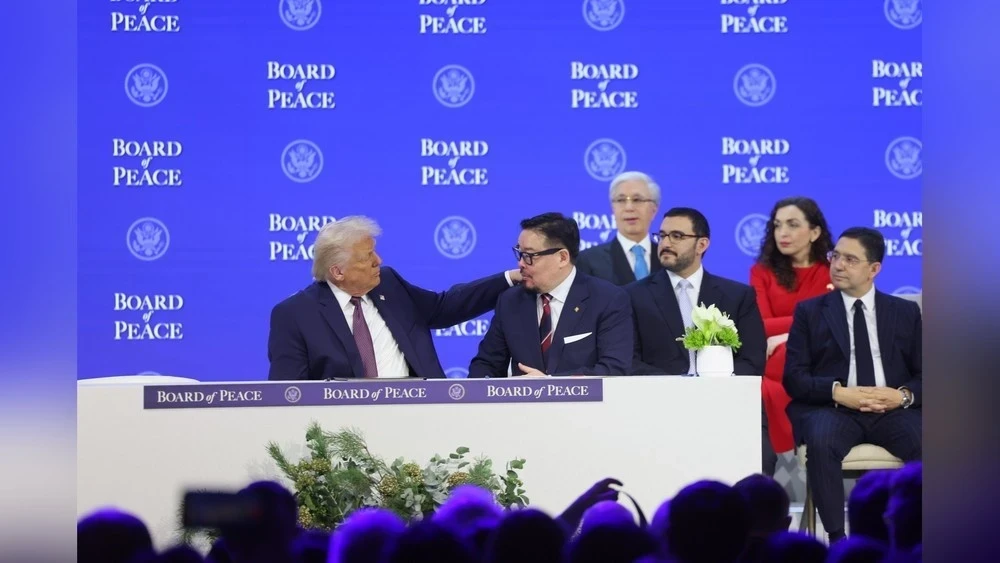
The administration of Zandanshatar became one of the founders of the new body, despite the refusal of the democratic allies of the USA to participate in it.
During the World Economic Forum 2026 held in Davos, Switzerland, the Prime Minister of Mongolia, Zandanshatar Gombojav, announced the country's accession to the Council of Peace, established at the initiative of the USA, as one of its founders. The decision to quickly join this international organization drew criticism; however, the government claims that this step aligns with Ulaanbaatar's multi-vector foreign policy and helps protect national interests.
On January 22, at an event in Davos, US President Donald Trump announced the establishment of the Council of Peace. Initially, this structure was conceived to oversee the implementation of a 20-point peace plan for Gaza and the restoration of the region, but later transformed into a platform for international cooperation aimed at resolving global conflicts. Mongolia became one of the founders of the Council during the signing of its Charter.
After signing the Charter, Prime Minister Gombojav's cabinet emphasized that "the Council of Peace is not a military organization, but a platform for voluntary cooperation with respect for national sovereignty, which fully corresponds to Mongolia's independent, peaceful, and multi-vector foreign policy."
The Prime Minister's administration informed researcher Bolor Lkhaajav that "Mongolia's accession to the Council of Peace demonstrates its independent approach to foreign policy."
In an official government press release, three main reasons were highlighted for why Mongolia decided to become part of the Council of Peace:
"Mongolia, as a responsible state striving for peace, will support a new flexible mechanism for the peaceful resolution of conflicts, which will strengthen its international positions and create opportunities for a clearer self-representation, as well as improve the country's security and independence through political and diplomatic means within the framework of international law."
Mongolia has experience participating in international peacekeeping operations. The Council of Peace is not a military alliance, but a platform for voluntary cooperation, which aligns with Mongolia's independent and peacekeeping foreign policy.
The threshold of 1 billion dollars specified in the Charter pertains to the extension of membership for 3 years and is not a mandatory condition for Mongolia, allowing the country to participate as a regular member on a voluntary basis, according to its capabilities and interests.
The US Ambassador to Mongolia, Richard Buangan, congratulated Prime Minister Zandanshatar, noting: "We are pleased that Mongolia has become one of the founders of the Council of Peace." This initiative, implemented under President Trump's leadership, aims to restore peace in Gaza.
Some experts note that Ulaanbaatar hastened to join various international initiatives, while other states continue to assess the work of the new Council of Peace. Mongolia, in turn, seeks partnership with countries such as Japan, South Korea, Poland, and several European states, which also express caution regarding Trump's actions.
From the perspective of bilateral relations with the USA, Mongolia's membership in the Council of Peace continues the strategic partnership established during Trump's first term in 2019.
The Deputy Head of the Mongolian Diplomatic Mission in the USA, Battushig Zanabazar, noted in an interview with The Diplomat that "participation in this initiative at the initial stage will provide Mongolia with strategic advantages." Supporting the Council, which is a key initiative of the Trump administration, sends a positive signal about Mongolia's intentions towards the USA. He also added that this will strengthen Mongolia's strategic partnership with the United States and help deepen political trust.
Since Mongolia joined the UN in 1961, its presence and contribution on the international stage have been recognized. However, in the past, Mongolia faced difficulties in attempting to join international organizations, highlighting the historical significance of the current decision to join the Council of Peace.
Mongolia's decision to enter the Council of Peace can be viewed as a step reflecting its historical memory of key moments related to the end of World War II and the formation of a new international order.
Today, the world faces similar challenges, and Mongolia's choice to join the Council of Peace may become an important milestone as the country seeks to protect its independence and sovereignty, as well as develop mechanisms for conducting an independent foreign policy.
In recent decades, Mongolia has expanded its membership in international organizations, from observer status to participation in the Shanghai Cooperation Organization and temporary membership in the Eurasian Economic Union (EAEU). According to Zandanshatar's administration, the Council of Peace may open up opportunities to strengthen economic ties with Gulf states, including the United Arab Emirates, Bahrain, and Saudi Arabia. This aligns with Mongolia's strategic goals.
Despite Mongolia's desire to develop economic ties through the Council of Peace, it is important that the country's foreign policy remains consistent with its other international commitments. Mongolia's membership in the Council of Peace should not contradict its obligations to the UN, which continues to be an important forum for diplomatic negotiations. Joining the Council of Peace, while it may seem hasty, does not imply a change in the country's foreign policy strategy.
At the same time, any additional agreements and cooperation mechanisms should be discussed at the legislative level to ensure that they align with Mongolia's democratic principles and its long-term commitment to maintaining peace and security.
Author: Bolor Lkhaajav — a researcher specializing in Mongolia, China, Russia, Japan, East Asia, and America. She holds a Master's degree in Asian-Pacific Studies from the University of San Francisco.
Translation: Tatar S.Maidar
Source: The Diplomat


