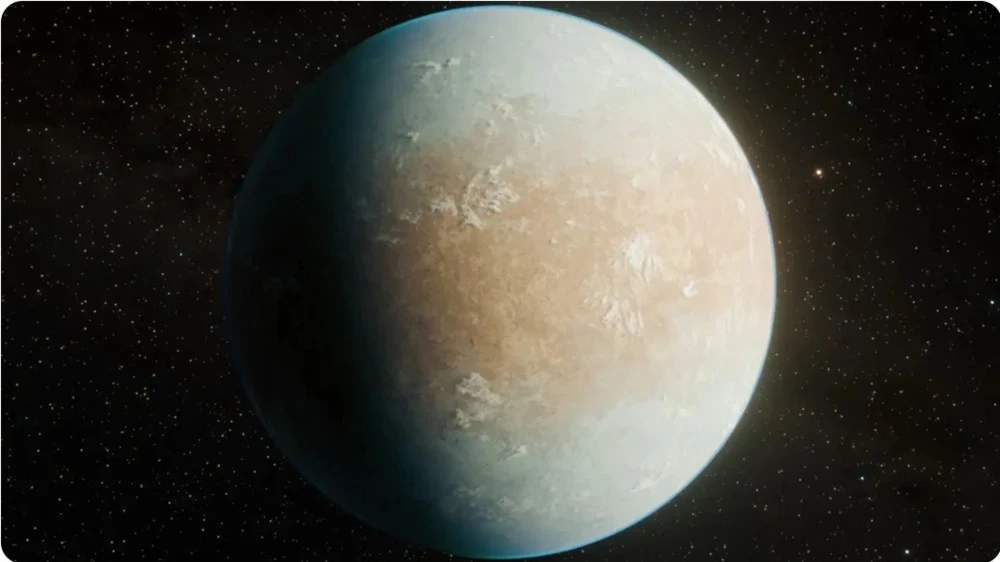
An artistic depiction of the planet HD 137010 b, Earth-sized,
The discovery was made based on data collected by NASA's Kepler space telescope during its K2 mission back in 2017. Analysis results indicate that HD 137010 b is only 6% larger than Earth, and its year lasts 355 days. Researchers estimate the probability that the planet is in the "habitable zone" at 50%, suggesting the possibility of liquid water. However, despite the similarity in orbits, the climate on this planet may be significantly harsher than on Earth. The parent star of HD 137010 b resembles our Sun, but it is less bright and cooler. "It is assumed that the temperature on the planet's surface could reach values close to Martian levels, with possible drops to -70 degrees," comments the research team. Dr. Sarah Webb from Swinburne University of Technology suggests that there are significant water reserves on the planet, but most of it may be in a frozen state. Dr. Chelsea Huang from the University of Southern Queensland emphasizes that the importance of the discovery lies in the proximity and brightness of the star: it is located approximately 150 light-years away from us. In comparison, the nearest known exoplanet, Kepler-186f, is four times farther away and nearly 20 times less bright. This creates excellent conditions for future research: next-generation telescopes will be able to study the atmosphere and surface of this planet in detail due to its proximity and the brightness of its star.