
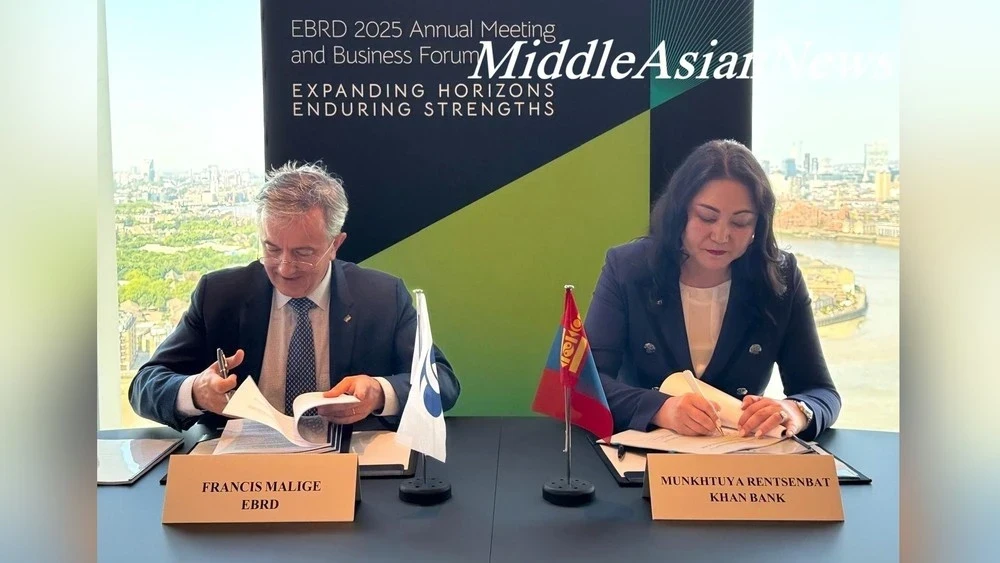
According to MiddleAsianNews, the European Bank for Reconstruction and Development (EBRD) has invested nearly $2 billion (€1.72 billion) in 120 projects across Central Asia and Mongolia. This has become one of the bank's best results in this region over the past ten years.
Uzbekistan has once again become the leader in receiving funding from the EBRD in 2025, receiving over $1 billion (€880 million). Kazakhstan was allocated nearly $440 million (€378 million), Mongolia $218 million (€188 million), the Kyrgyz Republic $212 million (€183 million), and Tajikistan $100 million (€88 million).
Among all projects, nearly one-third of the funds were directed towards developing sustainable infrastructure. Another third went to supporting local banks that provide loans to small and medium-sized enterprises (SMEs), as well as women and young entrepreneurs. The remaining 15 percent was allocated to support private companies operating in the manufacturing and services sectors in Central Asia. Many of these projects contributed to attracting foreign direct investment, with 68 percent of the loans supporting private initiatives and 53 percent of the investments directed towards "green economy" projects.
Renewable Energy
In Uzbekistan, the EBRD allocated $142 million (€121 million) for the development of the largest solar photovoltaic power station in Central Asia with a capacity of 1 GW and an energy storage system (BESS) of 1336 MWh. The project is being implemented in partnership with ACWA Power and marks the first investment by Japanese partners in Uzbekistan's renewable energy sector.
To construct a new solar power station with a capacity of 300 MW and a storage system of 75 MWh in the Kashkadarya region, the EBRD organized financing of up to $195.5 million (€168.5 million). This project is being developed by Masdar, a well-known player in the renewable and clean energy market.
In Tajikistan, a large-scale modernization of the Kairakkum Hydroelectric Power Station has been completed, including the commissioning of six hydro units, which increased the installed capacity from 126 MW to 174 MW. This will ensure stable electricity supply for 500,000 residents of the Sughd region.
Sustainable Infrastructure
As part of a sovereign loan from the EBRD of up to $250 million (€240 million), 110 irrigation pumping stations will be modernized in ten regions of Uzbekistan. It is expected that the new energy-efficient pumps will reduce electricity consumption by 251,000 MWh and decrease CO₂ emissions by more than 117,000 tons per year.
Financing of up to €45 million provided by the EBRD in conjunction with the European Union will be used to increase the capacity of the Aktau port, the main seaport of Kazakhstan on the Caspian Sea, which plays a key role in the Trans-Caspian corridor.
In Tajikistan, a sovereign loan from the EBRD of up to €38 million and a grant from the Asian Development Bank (ADB) of $86.7 million (€83.5 million) will help carry out the modernization and expansion of the road from Dangara to Gulishton, which is an important artery between the north and south of the Khatlon region, where more than 53 percent of the country's agricultural production is concentrated and 35 percent of the population resides.
In the Kyrgyz Republic, the EBRD allocated €62 million for the construction of a new 500 kV power transmission line spanning 53 km between Kemin and Balykchy near Issyk-Kul. These funds will also allow for the creation of a new 500 kV substation in Balykchy.
A financing program of up to €23.8 million from the EBRD and the EU will support the reconstruction and automation of the Western Big Chui Canal — the largest irrigation system in the Kyrgyz Republic. Additionally, the EBRD and the EU have allocated up to €38 million for the modernization of critical infrastructure, including water intakes and distribution networks in Jalalabad and Naryn.
The EBRD's "Green Cities" initiative promotes sustainable urban development. The city of Osh in the Kyrgyz Republic has joined the program, planning to improve wastewater treatment facilities and develop eco-friendly public transport with a loan of up to €14.7 million and a grant of up to €8.3 million.
In Ulaanbaatar, Mongolia, a specialized cardiology hospital will also be built using a sovereign loan from the EBRD of up to $34.9 million (€33.5 million) as part of the "green cities" plan.
Financial Sector and Support for Small Business
In Mongolia, about 74 percent of annual EBRD investments were directed to the real sectors of the economy through partner financial institutions.
Among the projects are credit lines totaling up to $147 million (€135 million) issued to XacBank under the "Youth in Business" program — this is the largest EBRD deal with a Mongolian bank to date. A loan of $20 million (€16.8 million) was also provided to Khan Bank, which became the first specialized credit fund for agribusiness in Mongolia and Central Asia, and a package of $20 million (€17.2 million) was issued to Golomt Bank to support women's and youth entrepreneurship.
In Uzbekistan, projects with partner banks accounted for nearly 39 percent of the annual volume of EBRD operations in the country, including deals with Hamkorbank, Ipak Yuli Bank, and Universalbank totaling $125 million ($108 million) to support SMEs and "green" investments.
In Kazakhstan, CenterCredit Bank was allocated three loans totaling $60 million (€57.6 million), which will be used to create growth opportunities for SMEs owned by young people or women. KMF Bank also received a loan of up to $25 million (€22.9 million) to support women entrepreneurs, while the microcredit fund Arnur Credit received up to $7 million (€6 million) under the "Youth in Business" program.
In 2025, the EBRD supported over 4,600 small and medium-sized enterprises in Central Asia and Mongolia, providing consulting, training, and mentoring. Three companies from the region (logistics company Jana Post from Kazakhstan, greenhouse vegetable producer LST Agro, and Tajik company Oilai Barakat) entered the "Blue Ribbon" program for fast-growing SMEs.
The bank initiated its first regional Star Venture program in Central Asia, bringing together promising startups from four countries into a single community to strengthen ties and accelerate innovation.
In 2025, the EBRD signed 31 risk-sharing agreements with 26 companies in Central Asia, unlocking new opportunities for local businesses.
Last year, the bank celebrated the tenth anniversary of its "Women in Business" program in Central Asia and Mongolia, under which more than 100,000 women entrepreneurs received about $365 million (€305 million), and over 17,000 women underwent training and received consulting.
The EBRD is a leading institutional investor in Central Asia, having invested over €21 billion in 1,250 projects.


