
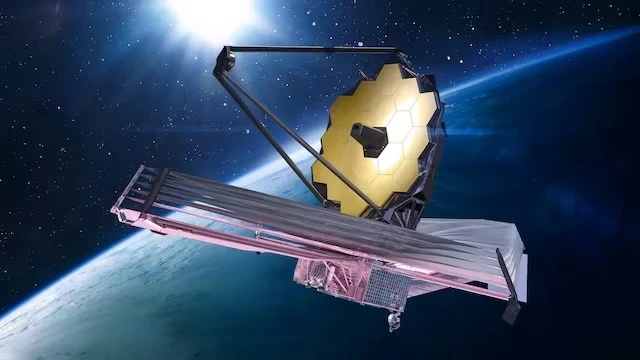
The James Webb Space Telescope. Photo NASA/dima_zel/Handout via Reuters.
Using the James Webb Space Telescope, scientists have been able to create the most detailed map of dark matter distribution to date, reports Reuters. This mysterious substance makes up a large part of the matter in the Universe but remains invisible to the human eye.
The observations were conducted over a significant area of the sky, nearly three times the size of the visible disk of a full moon. This allowed researchers to "see" dark matter, which does not emit or reflect light.
The creation of the new map was based on the effect of gravitational lensing — the bending of light due to mass. The telescope recorded slight distortions in the shapes of about 250,000 distant galaxies caused by the gravitational influence of matter between them and Earth.
Previously, such maps were created using data from the Hubble Space Telescope, but the capabilities of the James Webb allowed for images with twice the resolution and the exploration of larger areas of space, looking back in time 8–10 billion years — during the active formation of galaxies.
According to researchers, the new map with unprecedented clarity demonstrates the so-called "cosmic web" — a vast structure of the Universe consisting of clusters of galaxies, long strands of dark matter, and large voids between them.
The James Webb Space Telescope, launched in 2021 and beginning scientific observations in 2022, operates in the infrared range and has a light-gathering capability about six times greater than that of Hubble. This allows it to detect fainter and more distant objects.
Researchers note that "the Webb telescope provides us with new opportunities to observe the Universe. We see many more galaxies with high clarity, which directly improves the accuracy of dark matter maps."
The map covers an area of the sky in the direction of the constellation Sextans, known as the COSMOS project. Scientists hope that this data will help deepen the understanding of the processes of galaxy formation and evolution, as well as confirm existing theories about the structure and development of the Universe.
This research also aligns with the current cosmological model, which states that the Universe is primarily composed of dark matter and dark energy — a mysterious force responsible for the accelerated expansion of the cosmos.


