
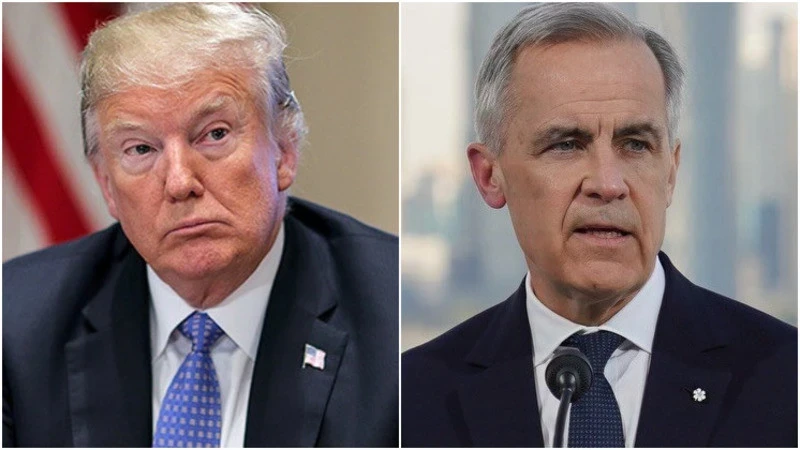
Donald Trump, Mark Carney
Trump expressed his position on social media, emphasizing that if Canadian Prime Minister Mark Carney thinks he can make his country a "dumping ground" for China, he is very mistaken.
This week, Canada signed an agreement that involves reducing tariffs on Chinese electric vehicles in exchange for lowering taxes on imports of Canadian agricultural products. Trump initially rated this agreement positively, noting that Carney "should be doing this."
Canadian Trade Minister Dominic LeBlanc stated that Canada and China have resolved a number of important trade issues, but do not aim to conclude a free trade agreement.
Trump's threat came amid an escalating conflict with Carney. In Davos, Trump stated that "Canada exists because of the United States," to which Carney responded that his country thrives due to the efforts of its citizens, not because of the U.S.
Following this, Trump rescinded Carney's invitation to join his "Peace Council," which he is creating to resolve global conflicts.
Trump has repeatedly expressed doubt about Canada's sovereignty, suggesting that it should become the 51st state of the U.S. This week, he posted a modified image of a map on social media, depicting Canada, Venezuela, Greenland, and Cuba as part of the U.S.
On Saturday, Trump continued his provocations, referring to Carney as "governor," just like his predecessor Justin Trudeau.
Carney is urging other countries to unite against U.S. policies under Trump. In his speech in Davos, he noted that "middle powers must act together" to counter coercion from great powers, emphasizing that the rift between the U.S. and its Western allies that emerged under Trump will never be repaired.
On the same day, Trump stated in a post on Truth Social that "China will swallow Canada," warning of the potential destruction of the Canadian economy and way of life. He added that "the world does not need China to take over Canada," assuring that this will not happen.
So far, Carney has still not reached an agreement with Trump on reducing tariffs on key sectors of the Canadian economy that were imposed earlier. However, Canada has managed to protect itself from the most serious consequences of the tariffs thanks to an agreement with the U.S. and Mexico, which will be reviewed this year.
Canada is an important trading partner for 36 U.S. states. Every day, goods and services worth nearly 3.6 billion Canadian dollars cross the border, with about 60% of U.S. crude oil imports and 85% of electricity imports coming from Canada.


