
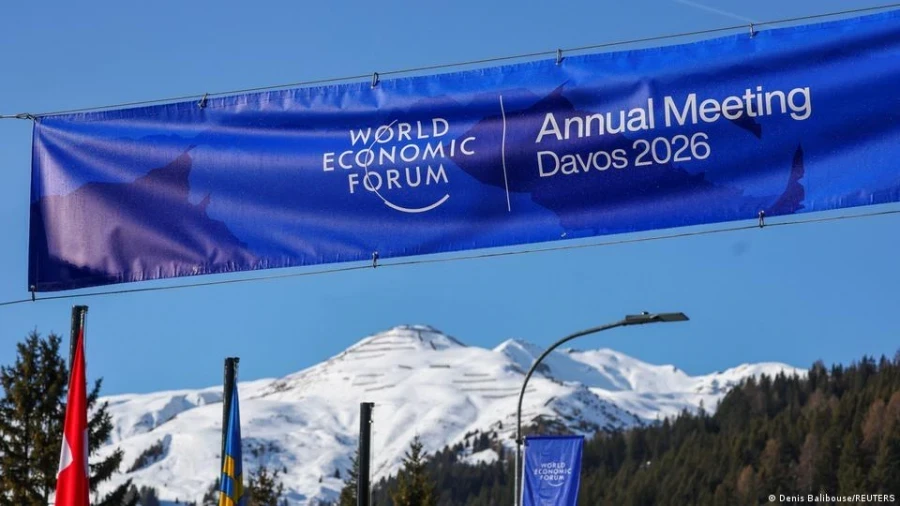
The discussion of security, economy, and artificial intelligence issues will be central at the forum.
The 56th World Economic Forum (WEF) took place in Davos, gathering the world's political and economic elite. RBC provided up-to-date information on its proceedings.
From January 19 to 23, 2026, the forum will serve as a platform to discuss key issues such as international security, economic problems, and artificial intelligence. This year's theme is "The Spirit of Dialogue".
Davos, known as a ski resort, has hosted this forum annually since 1971, located at an altitude of over 1500 meters in the Alps of eastern Switzerland.
This year, more than 60 heads of state and government, 55 ministers of economy and finance, and over 800 highly professional managers will participate in the forum. Among the business participants will be Nvidia President Jensen Huang, as well as Microsoft and Anthropic leaders Satya Nadella and Dario Amodei.
Each company pays 27,000 Swiss francs ($33,600) for each delegation member, in addition to the annual membership fee.
To ensure the security of the forum, more than 5,000 military personnel, including snipers, as well as drones with artificial intelligence, will be deployed. The expected security expenses in 2026 will amount to about 9 million Swiss francs ($11.2 million).
Before the start of the WEF summit, a survey was conducted among 1,300 business leaders, scientists, and representatives of public organizations. They identified "geoeconomic confrontation" as the main threat, mentioned by 18% of respondents. 14% pointed to the danger of armed conflict, while 8% highlighted extreme weather events.
According to UN data, global military spending in 2024 reached $2.7 trillion, which is 9.4% more than the previous year, marking the most significant increase since the end of the Cold War.
G7 leaders, including French President Emmanuel Macron, will also visit Davos. Japanese Prime Minister Sanae Takahichi will not be able to participate; he will be replaced by Minister of Economy Ryosei Akazawa and Minister of Finance Satsuki Katayama.
Among the participants will also be European Commission President Ursula von der Leyen, UN Secretary-General António Guterres, and World Trade Organization head Ngozi Okonjo-Iweala. China will be represented by Vice Premier He Lifeng.
The largest delegation is expected to be from the United States, led by President Donald Trump. It will include Secretary of State Marco Rubio, Secretaries of Finance and Commerce Scott Bessent and Howard Latnik, Trade Representative Jamison Greer, Special Presidential Envoy Stephen Witkoff, Trump’s son-in-law Jared Kushner, and members of Congress.
Russia has not been invited to the forum in Davos, and official Russian representatives have been absent from the event since 2022. However, on January 19, Reuters reported the possible participation of Russian President Vladimir Putin's special envoy Kirill Dmitriev, who may meet with members of the American delegation, although there has been no official confirmation of this information.
The Ukrainian delegation will also be present at the forum, planning meetings with U.S. representatives, as reported by Ukrainian Foreign Minister Andriy Sibiga.
According to information from FT, Ukraine's G7 allies intend to secure Trump’s support for ensuring the security of Kyiv. A meeting between the presidents of the U.S. and Ukraine is scheduled to take place on the sidelines of the forum, which will also involve G7 leaders and von der Leyen. Trump has not yet confirmed his plans to meet with Zelensky, although he does not rule out the possibility of contact if the Ukrainian president attends the forum.
According to reports from The Telegraph, the U.S. and Ukraine may sign an agreement on the reconstruction of Ukraine after the conflict worth $800 billion. Ukraine's ambassador to the U.S. Olga Stefanishina confirmed that Kyiv is working on such an agreement.
On January 19, FT reported adjustments to the forum's agenda. Initially, discussions on Ukrainian peace negotiations were planned, but the topic was changed due to foreign policy factors and threats from the U.S., to also address the situation in Greenland.
Before the start of the WEF, Trump announced the creation of a Council for Peace aimed at restoring the Gaza sector. According to Axios, he intends to launch the Council's work at the forum in Davos.
The structure of the Council has not yet been determined, but it is known that Trump will lead it and decide whom to invite. Invitations have already been sent to Argentine President Javier Milei, Canadian Prime Minister Mark Carney, Turkish President Recep Tayyip Erdoğan, and von der Leyen. Letters have also been sent to the leaders of France, Germany, and Australia, reports Reuters.
According to The Atlantic, the future organization's charter does not mention the Gaza sector. However, the Council will receive a two-year UN mandate, and the term of office for its members will be three years. A contribution of $1 billion in the first year makes the term of office permanent, which may indicate more ambitious plans. Reuters refers to the Council as "Trump's UN," which ignores the main provisions of the UN Charter. Previously, Trump criticized the international organization for its ineffectiveness.
Photo www


