
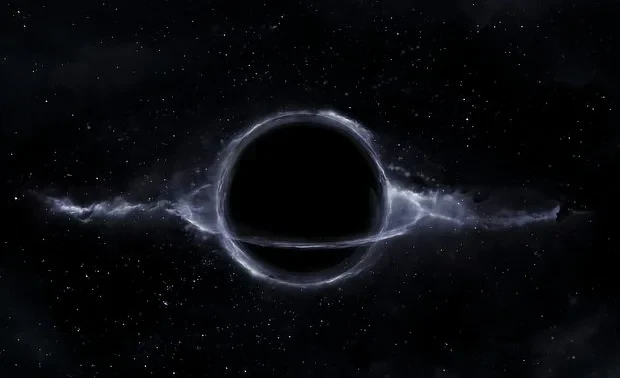
After nearly 100 million years of inactivity, one of the supermassive black holes in a distant galaxy cluster has reactivated, as reported by Popular Science, citing data from Lenta.ru.
A study conducted under the guidance of astronomer Shobha Kumari from Midnapore City College in India showed that such black holes rarely eject magnetized plasma that emits radio waves.
The object designated J1007+3540 exhibits behavior reminiscent of volcanic activity, ejecting plasma into intergalactic space.
It is specified that the length of the jets ejected by this object is approximately one million light-years — nearly ten times the width of the Milky Way. This study emphasizes the fact that black holes are not always in an active phase of matter absorption and can remain in a dormant state for extended periods.
The return to activity is accompanied by complex processes that reflect the interaction of the internal forces of the black hole and the pressure from the surrounding environment, as noted in the article.


