
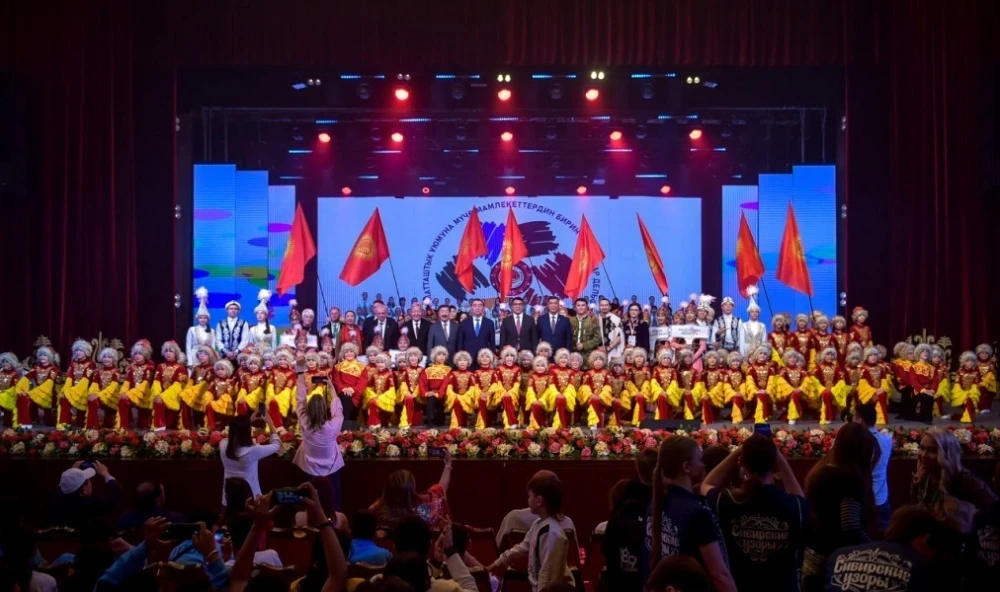
Bishkek has become the venue for the first youth Delphic Games for the member countries of the Shanghai Cooperation Organization, temporarily transforming into a center of art and creative achievements. The opening of the games took place yesterday at the Toktogul Satylganov National Philharmonic, where an atmosphere of friendship, brightness, and solemnity prevailed.
High-ranking guests attended the ceremony, including the Deputy Prime Minister of Kyrgyzstan Edil Baisalov, ambassadors from SCO countries, the mayor of Bishkek, an advisor to the SCO secretariat, the director of the International Delphic Committee, and the chairman of the Delphic Committee of Kyrgyzstan. A total of 700 people are participating in the project, including 300 international participants from Tajikistan, Uzbekistan, Kazakhstan, China, India, Pakistan, Iran, Belarus, and Russia, as well as 400 representatives from Kyrgyzstan. Guests were entertained by the best musical and dance groups in the country, including winners of previous Delphic Games, who demonstrated a high level of skill in playing the piano, violin, and guitar.
The event was given special significance by a greeting to the participants of the Games from the President of Kyrgyzstan Sadyr Japarov, which was announced by Edil Baisalov. The President emphasized that holding such large-scale Games highlights the cultural diversity and historical heritage of the SCO countries, as well as unites youth, contributing to the strengthening of cultural ties and the discovery of new talents. He wished the participants good luck and inspiration. The ceremony also featured a message from the Secretary-General of the SCO, Nurlan Ermekbaev.
Edil Baisalov noted that hosting the Delphic Games in Bishkek demonstrates the country's active participation in humanitarian cooperation within the framework of the SCO and confirms its commitment to the development of intercultural dialogue. "These Games should become an important platform for preserving and popularizing national cultures and showcasing the talents of young performers," he said, adding that the festive atmosphere would help participants realize their bold plans and achieve success.
The mayor of Bishkek, Aibek Junushaliev, noted that it is a great honor for the capital to host such a significant international cultural event that brings together young talents and artists. "The Delphic Games are a space for art where talents are revealed and new ideas emerge, strengthening friendly ties between nations," he emphasized.
This is the first time the Games are being held under the auspices of the SCO, which celebrates its 25th anniversary this year. The first youth Delphic Games are not just a competition but a true cultural forum that, as participants and spectators noted, will strengthen international ties and expand friendly interactions among youth from different countries.
The Delphic Games will run until March 28 and include eight competitive categories: piano, visual arts, folk and pop vocal arts, folk dances, DJing, performance on folk instruments, and decorative and applied arts.
In the world of art, the Delphic Games hold a position analogous to the Olympic Games in sports. This project represents a system for discovering and supporting young talents, facilitating the self-realization of youth in various fields. To date, more than 100 global, international, and national Delphic Games have been held, becoming a notable phenomenon in international relations.
History of the Delphic Games
The Delphic Games are competitions in artistic, applied, and research creativity. Their roots trace back to the Pythian Games, which were held in Ancient Greece in honor of the god Apollo. These games began in 582 BC and were held every four years, preceding the Olympic Games, until their prohibition in 394 AD by the last ruler of the Roman Empire, Theodosius I.
The revival of artistic competitions occurred thanks to French Baron Pierre de Coubertin at the V Summer Olympics, but they were discontinued in 1948 due to funding issues. In the 1970s, work began in the USSR to revive the Delphic Games as part of creative events organized by youth organizations.


