The problem of stray animals in Bishkek: how authorities are responding to the situation
Events related to stray animals traditionally unfold according to a well-known script: alarming headlines, emotional footage, officials' statements about "necessary measures," and promises to quickly resolve the problem. Society is divided into two camps: some demand harsh measures for safety, while others advocate for humanity. However, the main question remains open: does shooting animals really solve the problem, or is it just a show of power?
The tragedy in Novopavlovka: two killed and one injured dog
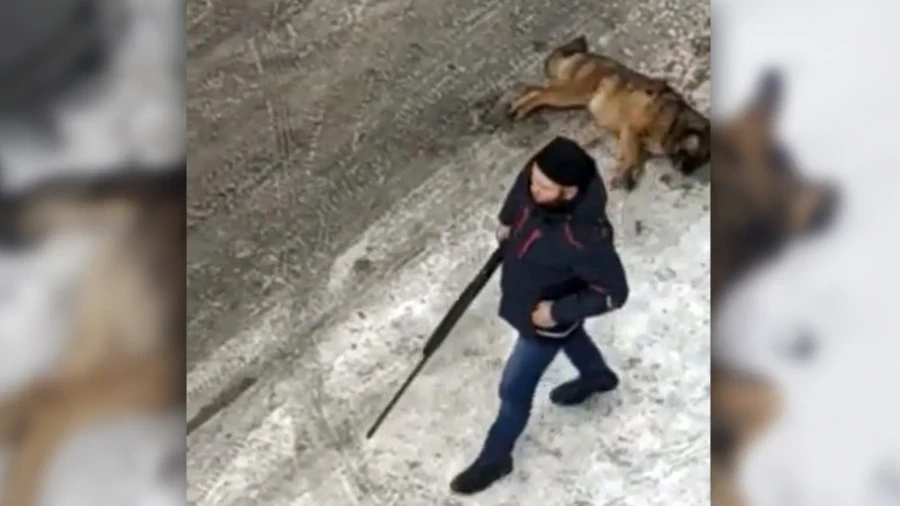
A shocking video surfaced on social media, quickly attracting attention. The footage shows armed employees of the municipal enterprise "Tazalyk" shooting two dogs in the yard of a private home, all in front of a child and the owners. The screams and panic in the video led to its viral spread.
According to Irina Krasnova, the homeowner, no one attempted to contact the dog owners before or during the shooting. The employees did not identify themselves, did not knock on the door, and did not request documents for the animals. The child, hearing the gunshots, ran into the yard, and the family feared that the bullets could hit him too.
This incident became the central topic of discussion: it was no longer just about the fate of the animals, but also about the safety of people.
- My husband is currently in intensive care, and my daughter is still afraid of loud noises, - says activist Irina Krasnova. - Two dogs died, and one was injured. We are not just talking about animals — armed individuals came to our home and opened fire. I plan to file a lawsuit and seek a legal assessment of these actions.
This case intensified public discussions: questions about the fate of animals are now linked to threats to people.
The Bishkek city hall explained that the actions were aimed at sanitary safety and combating stray animals and were conducted based on permits. Vice Mayor Ramiz Aliyev mentioned at a meeting of the Bishkek City Council that animal rights activists and private individuals often keep a large number of animals in their yards — sometimes up to 120, which creates problems for neighbors.
Nevertheless, such explanations did not calm the public. On the contrary, accusations against the vice mayor poured in, with his actions labeled as inhumane and deceitful. According to Irina Krasnova, her dogs were sterilized, vaccinated, and had veterinary passports, and the total number of animals actually did not exceed eight.
Where do stray dogs come from?
In public discussions, stray animals are often perceived as an independent threat, as if they appear on their own. In reality, most street dogs and cats are former pets or their offspring. Uncontrolled breeding, spontaneous trading, and the absence of mandatory microchipping contribute to a constant influx of animals onto the streets.
- We can talk about catching them as much as we want, but as long as people continue to throw dogs onto the street, the situation will not change, - says activist Mila Sokolova. - Without a law on controlled breeding and real fines for abandoning animals, any capture program will be endless. Today, some animals are removed — tomorrow, new ones will appear. It’s a vicious circle that cannot be broken without holding owners accountable.
Until a mandatory accounting system and substantial fines for abandoning animals are implemented, any shooting programs will resemble an attempt to bail water out of a boat with a hole.
How can the problem be solved?
As an alternative to the forceful method, activists propose the "Kumayyk" program, which operates in Kant and neighboring settlements with the support of international partners. In this program, animals are captured, sterilized, vaccinated against rabies, and marked for accounting, and then either returned to their familiar environment or handed over to caring hands.
According to activists, the funds allocated for shooting can be redirected to creating shelters and mass sterilization, which will allow for a natural reduction in the number of street animals over time. They consider this approach civilized and conducive to fostering a culture of humanity and responsibility in society.
International practices confirm that systematic population management without violence is more sustainable. For example, in Georgia, a municipal scheme for capturing, sterilizing, and vaccinating animals with subsequent marking is implemented in major cities. Turkey has also used a similar model that reduced breeding without mass extermination. In most European countries, the emphasis is on mandatory identification of animals and accountability of their owners, with extermination allowed only in exceptional cases.
Shooting as a show of force…
When municipal services carry out the task of "reducing the population," an illusion of control is created. This easily fits into a television format: there is a threat — there is a reaction. However, behind the scenes lies statistics that rarely make it to the airwaves.
Experts talk about the "vacuum effect": exterminating part of the population does not solve the problem but merely creates conditions for new animals to arrive.
- Shooting will not solve the problem; it will only exacerbate it, - asserts animal rights activist Zulia Yangalycheva. - Nature does not tolerate a vacuum: by removing dogs, we create conditions for new ones. If we completely clear the area, it will lead to an increase in the population of rodents and other animals, creating a risk of epidemics. A systematic approach is needed: sterilization, vaccination, and owner control, not shooting.
Shooting is not only inhumane but also fosters a perception in society that problems can be solved through violence. When people see animals being killed, it creates a sense that violence is an acceptable way to solve problems. Over time, this can lead to society becoming less sensitive to suffering, which, in turn, will affect attitudes toward people. The power of the state should manifest not in cruelty but in the ability to resolve complex issues through law and accountability.
…or corruption and financial machinations?
Activists suggest that the city hall's interest in the practice of shooting may be linked not only to a reluctance to conduct complex reforms but also to financial considerations.
In 2025, 7.5 million soms were allocated from the budget for these activities, but there is no transparency in the use of funds. Animal rights activists point to the lack of reporting: it is difficult to know how many animals were shot, how the disposal was carried out, and who controlled the process. It is this lack of transparency that raises concerns about corruption.
- In 2025, the city hall allocated almost 7.5 million soms for shooting, - notes volunteer Zulia Yangalycheva. – But who checks how much actually went to shooting and how much might have ended up in "wrong pockets"?
Discontent with Vice Mayor Ramiz Aliyev is growing. Many residents consider the approach too harsh and disproportionate, and the actions showy.
- The city faces many problems — from garbage to stray animals, and instead of a comprehensive solution, we see only media effects. The vice mayor has become more like a blogger: filming videos, making statements, but real changes are not felt. We need professional and transparent work, not a show, - says animal rights activist Tatyana Kulai.
As a result, activists are appealing to the mayor and president, demanding an assessment of Vice Mayor Ramiz Aliyev's competence and a reconsideration of the approach to solving issues related to stray animals. In their opinion, this concerns not only the protection of animals but also budget transparency and the professionalism of city services.