
The Chinese New Year, also known as the Lunar New Year or Spring Festival (Chun Jie), is a grand celebration with a millennia-old history, filled with fascinating legends and traditions. As this event approaches in 2026, which will take place on February 17, we will tell you how it is celebrated in China and what customs are associated with it.
Historical Roots of Chun Jie
This holiday has more than 3000 years of history, starting from the Shang Dynasty (1766-1122 BC), when farmers celebrated the beginning of spring work. Over time, the traditions of the holiday diversified, absorbing elements of local customs and creating colorful distinctions. For example, in Yunnan, competitions for launching sky lanterns are held, while in Shandong, stilt parades are organized.
Time of Celebration and the Element of Fire
The Chinese New Year is celebrated at different times each year, as its date is determined by the lunar calendar. The celebration begins on the second new moon after the winter solstice. In 2026, it will last until March 3, and the year will end on February 5, 2027. Although the Gregorian calendar is used in China, the lunar calendar still holds significant importance. The year 2026 corresponds to the year 4724 in the Eastern calendar. The lunar calendar is also used for other holidays and can influence age calculations.
Each new year is patronized by one of the 12 zodiac animals. The symbol for the year 2026 will be the Red Fire Horse, while 2025 will be under the sign of the Green Wooden Snake, and 2024 will be the Year of the Green Wooden Dragon. In Eastern culture, the Horse symbolizes movement and hard work, while the element of Fire enhances these qualities, adding passion and courage. The color red, as a symbol of luck, will dominate this year.
Traditions and the Red Table
The Chinese New Year is accompanied by family gatherings, festivals, and public celebrations, with fireworks being an integral part. According to legend, in ancient times, there was a monster named Nian that attacked people and livestock. People were able to scare it away using red decorations and the loud crackling of burning bamboo, which was later replaced by fireworks.
The color red has become the main symbol of the holiday: homes are decorated with red lanterns, and money is given as gifts to friends in red envelopes. It is believed that such actions attract good luck, so it is recommended to use red tablecloths and clothing during the celebration.
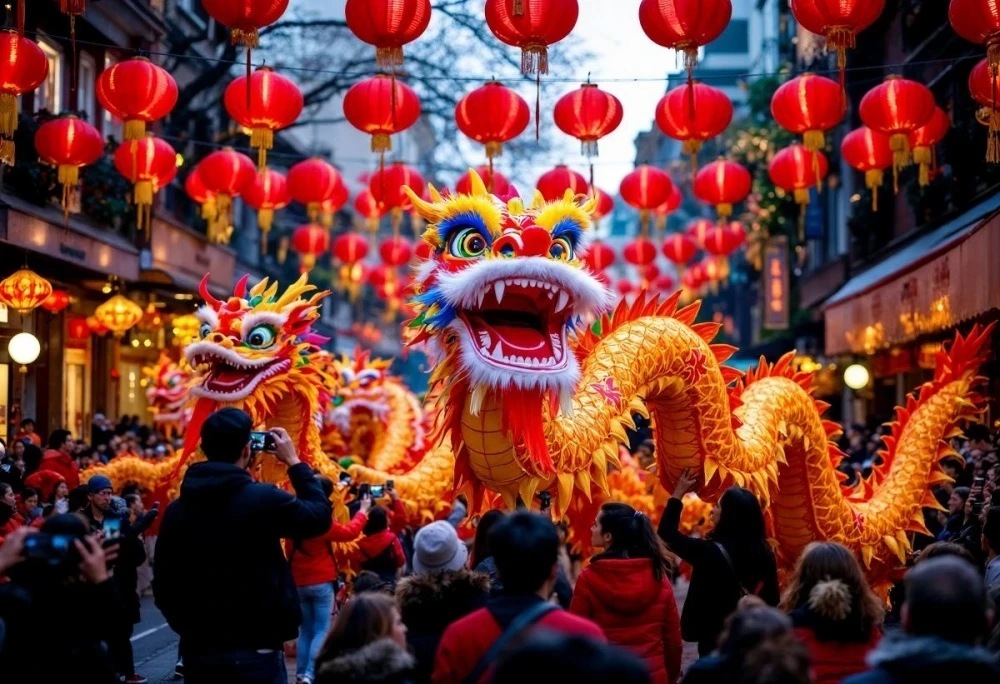
Parades featuring lion and dragon figures are also an important part of the traditions, where the lion symbolizes majesty, and the dragon symbolizes luck and life changes.
The Lantern Festival concludes the celebrations, when people take to the streets with lanterns that symbolize hope and happiness. Riddles attached to the lanterns add an element of play, providing an opportunity to win prizes.
Preparation for Chun Jie begins a month before it arrives, during a period known as Xiao Nian. Each day of this time has its significance, and one of the tasks is a thorough cleaning to "sweep out the old" before the New Year arrives, while during the festive days, efforts are made to minimize cleaning so as not to "sweep away luck."
Attention is also focused on settling debts, as it is believed that unpaid debts can carry over into the new year, creating financial difficulties. Symbolically, this is also relevant in other cultures.
Buying plants with symbolic meanings, such as peach tree branches for longevity and mandarin trees for luck, is also important for decorating the home.
Modern China experiences a massive population migration during the holidays, known as "Chun Yun," when millions of people return to their hometowns to reunite with families. Every year, more than 3 billion trips are made over 40 days, making ticket booking an important part of the preparation.
Symbolism of the Holiday
The period from Chinese New Year’s Day and throughout the following two weeks is filled with vibrant traditions, each carrying deep symbolic meaning. The celebration begins with a New Year’s dinner, which is considered the most important event among family.
On the table, there are always symbolic dishes, such as whole fish, long noodles, jiaozi dumplings, and sweet rice balls (tangyuan), which symbolize unity and happiness. After dinner, a series of rituals begins, including the launching of fireworks, aimed at driving away evil spirits and attracting good luck.
On New Year’s morning, people exchange greetings, and children receive red envelopes with money from their parents. In recent years, digital red envelopes through payment apps have become popular.
The Chinese New Year is not just a celebration but a whole palette of symbols and traditions reflecting the wisdom of the people. By congratulating each other with the phrase "Xin Nian Kuai Le!" we become part of this rich cultural tradition that connects the past and the present, East and West.
By the way, this holiday is also widely celebrated in educational institutions and Chinese-Kyrgyz enterprises in Kyrgyzstan.
Source: silunews.kg


