
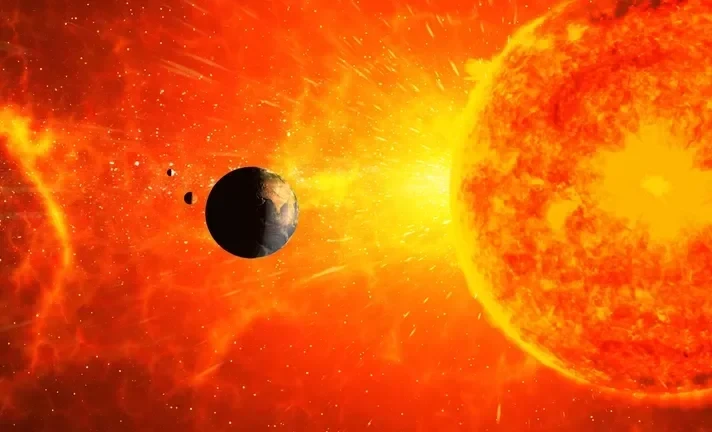
A research group from the Department of Astronomy at Moscow State University, in collaboration with international scientists, has developed an innovative method for assessing the potential habitability of Earth-like planets, which are often found near red dwarfs—the most common stars in our Galaxy. This work was supported by a grant from the Russian Science Foundation (RSF) and published in the journal Monthly Notices of the Royal Astronomical Society.
Experts explained that flares on red dwarfs, similar to solar flares, occur due to disturbances in the magnetic fields of these stars. This leads to energy bursts that can last from several minutes to several hours.
Red dwarfs have significantly stronger magnetic fields compared to yellow dwarfs, making their flares more intense. Increased activity of such stars may reduce the likelihood of life existing on the exoplanets surrounding them. Conversely, if the magnetic field of a red dwarf is stable, it may indicate a higher chance of habitability for planets in its vicinity, the RSF added.
The team of scientists from the Department of Astronomy at Moscow State University, including colleagues from France and the USA, proposed a new approach to assessing the activity of red dwarfs by recording each flare. A catalog of flare images was created, taking into account various interferences caused by satellites and other factors.
Working with such short-lived events requires analyzing vast amounts of data, which is a complex task, as emphasized by the RSF. In this regard, the scientists applied machine learning methods to automate the process of "scanning" photographs of the starry sky and detecting changes in the activity of red dwarfs.
"First, the machine learning algorithm needs to be trained. Since there were not enough real photographs of flares, we artificially created them by overlaying real flare signals recorded by a space telescope onto data of stars in a calm state. This allowed us to obtain a quality training sample for the algorithm," explained the RSF.
Using the new method, researchers found that red dwarfs of spectral class M4, with a temperature of about 3000 °C, exhibit flares much more frequently. In contrast, hotter stars of class M0 with a temperature of 3800 °C had flares recorded dozens to hundreds of times less frequently. It was also observed that flare activity decreased with increasing distance from the plane of the Milky Way: the farther a red dwarf was located, the older the stars became and the weaker their magnetic fields.
In the future, scientists plan to focus on searching for flares in star clusters, which will help better understand stellar evolution and identify the most stable red dwarfs, noted laboratory assistant Anastasia Lavrukhina from the Department of Astronomy at Moscow State University.


