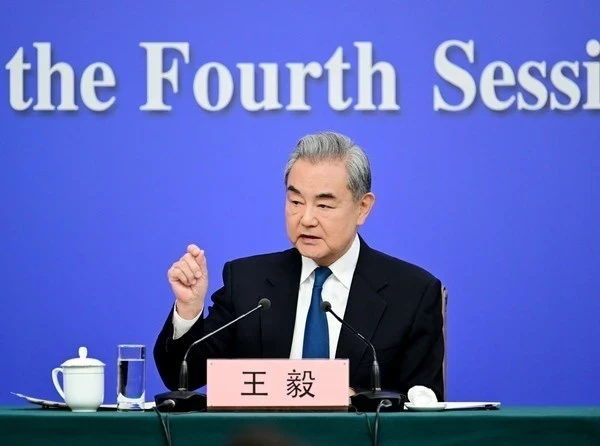
According to Wang Yi, the past year was filled with significant international events that played a key role in strengthening ties between world powers. He noted that 2025 was full of historical moments.
The minister emphasized that the visits of the Chinese leader to Southeast Asian countries, Russia, Central Asia, and South Korea contributed to the strengthening of good-neighborly relations with these countries. He also highlighted the SCO summit in Tianjin and the forum between China and Latin America as important steps towards the unity of the Global South. Wang Yi noted that the celebration of the 80th anniversary of victory in the War of Resistance against Japanese Aggression reaffirmed the commitment to peace. More and more countries around the world recognize that Chinese diplomacy, led by President Xi Jinping, plays an important role in stabilizing the international situation.
An important part of Wang Yi's speech focused on Chinese-Russian relations. He emphasized that the partnership between the two countries is based on equality, mutual respect, and benefit. These principles reflect a new type of international relations and set the course for the development of relations between great powers.
According to the minister, China and Russia share deep political mutual trust and cooperate on important international and regional issues, including the protection of international law.
Wang Yi stressed the significance of multilateralism and equality in international relations. He reminded that this year China will chair APEC, focusing on openness, innovation, and cooperation. This will be the third such event hosted by China, following Shanghai in 2001 and Beijing in 2014. Speaking about the upcoming 33rd informal meeting of APEC economic leaders in Shenzhen, the minister stated the intention to make this meeting a turning point in the formation of the Asia-Pacific community.
According to Wang Yi, the summit will discuss the theme of "building an Asia-Pacific community for common prosperity." The agenda will focus on three key areas: openness, innovation, and cooperation, which will help guide APEC on the path of progress. Plans include holding over 300 events across the country, involving various cities and provinces, to actively participate in this process.
Shenzhen, as an important center for reform and openness in China, will serve as the starting point for APEC on the path to creating an Asia-Pacific community, noted Wang Yi.
The minister also commented on the situation in the Middle East, emphasizing that China always advocates for peaceful solutions and calls for an immediate ceasefire. He expressed concern over the current conflicts, stating that war benefits no one and that diplomatic resolution is necessary.
Wang Yi listed the main principles that must be adhered to for resolving the situation in the Middle East, including respect for state sovereignty, prevention of violence, non-interference in internal affairs, political resolution of conflicts, and a constructive role for major powers.
As a strategic partner of the countries in the Middle East, China is ready to contribute to global peace and security, the minister stated.
Speaking about the implementation of the 15th Five-Year Plan, Wang Yi noted that this marks a new stage in China's development and its cooperation with foreign partners. He highlighted three main areas of work: increasing openness, developing mutual visits, and creating new platforms for cooperation.
The issue of Taiwan also became a topic of discussion. Wang Yi confirmed that Taiwan is an inseparable part of China and that any attempts at separation are doomed to fail. He pointed to the need to uphold the one-China principle and counter separatist sentiments.
The minister emphasized: "The resolution of the Taiwan issue is a matter of time and historical necessity. There is already a consensus in the international community supporting this principle."
In his speech, Wang Yi also touched on many international topics, including the Palestinian-Israeli conflict, sovereignty over Taiwan, and relations with other countries. He called for unity in the face of modern global challenges and joint efforts in building a community with a shared future for mankind.
"Humanity faces many challenges, and overcoming them requires solidarity. The concept of a shared future for mankind, proposed by President Xi Jinping, has become a response to the most pressing issues of our time," concluded Wang Yi.
The concept of a shared future for mankind also reflects China's commitments to the world, and China is ready to continue working towards its realization together with all partners.