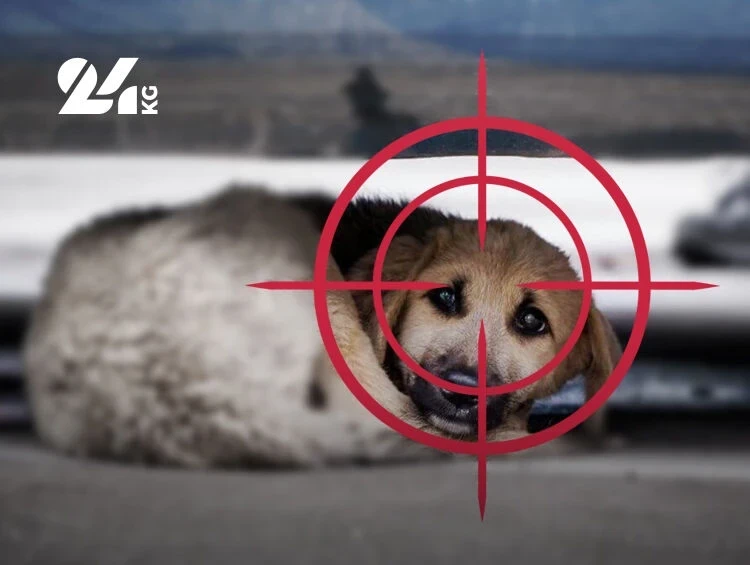
In Kyrgyzstan, the state policy regarding stray animals needs to be rethought. Deputy of the Jogorku Kenesh Gulya Kozhokulova, at a round table dedicated to the problem of stray animals, suggested focusing on eliminating the causes rather than the consequences. She believes that mandatory registration of pets, sterilization programs, and increased personal responsibility of citizens must be implemented.
Starting her speech, the parliamentarian pointed out that the situation with stray animals is a reflection of a crisis in both governance and the moral state of society.
“We are here to discuss a topic that many prefer to ignore or address with radical but ineffective methods. Stray animals in Kyrgyzstan are not only a humanitarian problem but also a reflection of our government’s performance and the maturity of society. Walking through the streets of Bishkek or Osh, we see the same picture: thousands of abandoned dogs and cats,” she noted.
Gulya Kozhokulova reminded that humane treatment of animals was part of her election program and called on city authorities to abandon violence in favor of creating shelters.
“This topic deeply concerns me. Bishkek should be comfortable for everyone, including our smaller friends. We must create municipal shelters for stray animals, providing them with food, sterilization, and medical assistance. Killing animals is not a solution, but simply cruelty. Caring for animals is a measure of our humanity and maturity. Bishkek should set an example of such an attitude,” she emphasizes.
Kozhokulova also highlighted the economic and biological impracticality of shooting, pointing to the ineffective use of budget funds:
“For a long time, shooting was the main method of regulating the number of animals in Kyrgyzstan, and unfortunately, it remains so. We must acknowledge that this method yields no results. Millions of soms are spent annually on ammunition and the work of special teams, yet the number of dogs on the streets does not decrease. Why? Because biology overcomes bullets. New individuals take the place of those killed, and the breeding rate only increases. We are simply throwing money into the void, choosing cruelty over rational solutions,” she added.
To address the problem, the deputy proposed three key legislative changes: microchipping, implementing an international system of TNR (Trap-Neuter-Return), and regulating commercial breeding.
“The authorities must stop acting like a 'fire brigade' that only responds to incidents that have already occurred. We need a strict legislative framework. First, mandatory registration and microchipping of pets. We need to know who owns the dogs that roam the streets. If a pet has no legal status, the owner bears no responsibility. Second, it is necessary to support TNR programs, which are recognized by the WHO as an effective and humane way to reduce the animal population in the long term. Third, we need to regulate breeding, as uncontrolled sales of puppies and kittens are a direct source of new stray animals,” she concluded.
The parliamentarian also emphasized that the responsibility for the problem of stray animals lies not only with the authorities but also with the citizens themselves, whose irresponsibility creates conditions for this situation:
“It is impossible to blame only the municipalities. Stray animals do not appear on the streets by chance. Each such animal is a result of human betrayal. We are facing a crisis of irresponsibility. In Kyrgyzstan, there is still a consumer attitude towards animals: a puppy is taken 'for protection' or 'for the children to play,' and when it becomes unnecessary or sick, it is simply thrown away. The problem lies not with the animals, but with the people who leave their pets in boxes by the trash bins. Society needs to understand: sterilization of pets that have no breeding value is not unnatural, but the only way to stop the influx of stray animals,” she added.
In conclusion, Gulya Kozhokulova called for joint efforts from experts, authorities, and citizens to transition to humane and civilized management methods:
“We need dialogue. The authorities must listen to animal rights activists and experts, and citizens must realize that the safety of children on the streets begins not with calling shooters but with responsible treatment of pets. We need state programs for subsidized sterilization, educational lessons in schools, and strict penalties for abandoned animals. We must move from a policy of addressing consequences to addressing causes. The level of civilization of society is determined by its attitude towards the most defenseless. Dogs and cats are completely dependent on us, and as long as we continue to solve the problem through violence, we remain in the last century,” the deputy summarized.
Author: Sofia Berezovskaya