
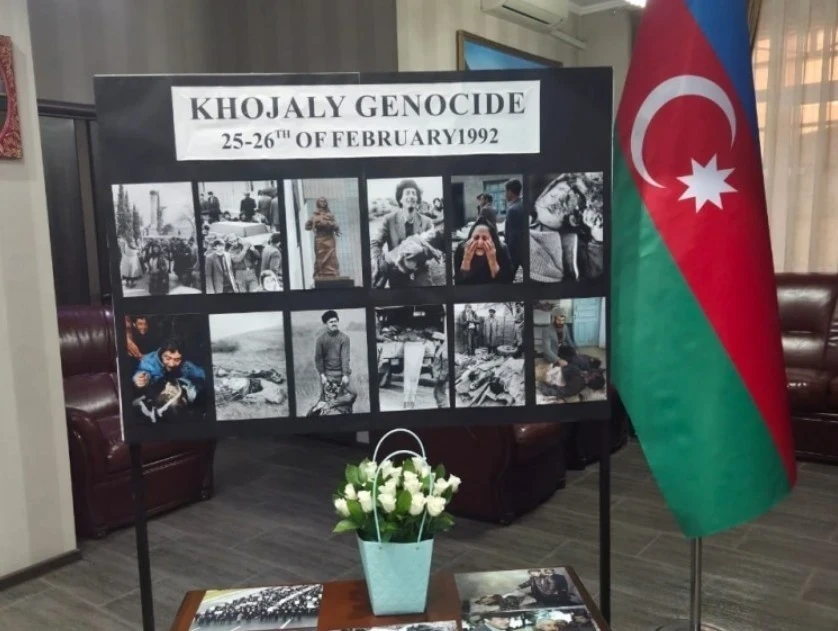
Speaking at the meeting, Latif Gandiyev, the extraordinary and plenipotentiary ambassador of Azerbaijan to Kyrgyzstan, shared his memories of those days, the historical context of the tragedy, and reflections on the significance of memory and justice.
- This day has become one of the most tragic in our nation's history. The pain we feel remains alive. Many of our employees were witnesses to those events, and we remember them as if they happened just recently, - he noted.
The ambassador emphasized that values of internationalism and respect for other cultures were instilled in his people from childhood. However, history has shown that nationalism can destroy even the strongest ties.
According to Gandiyev, the events that began in 1988 turned into a real tragedy for Azerbaijanis, who found themselves in a conflict for which they were unprepared. He noted that the international community often remained on the sidelines, preferring not to intervene in what was happening, which, in his opinion, only exacerbated the situation. As a result, more than 2,000 Azerbaijanis were brutally killed in Khojaly, which was a consequence of the desire to intimidate the people.
In the years that have passed since then, international organizations, including the UN, have adopted several resolutions, but Armenia ignored them. Azerbaijan was forced to rely on its own strength and, uniting around President Ilham Aliyev, liberated the occupied territories, restoring its sovereignty.
Throughout the 33 years of occupation, the Azerbaijani people faced numerous hardships: human losses, destruction, and forced displacement. The expected justice on the international stage has not been achieved. Nevertheless, the people maintained unity and strengthened their statehood.
Gandiyev emphasized the importance of memory, asserting that forgetting the lessons of history can lead to the repetition of tragedies. Therefore, they gathered to pass the truth to future generations and prevent similar events in the future.
He also reminded of other tragedies in history, such as the events of 1905-1907 and the March events of 1918, as well as the deportation of Azerbaijanis from 1947 to 1953, emphasizing that the events of the late 20th century were the result of long-term processes.
The ambassador noted that Azerbaijan has long sought a peaceful resolution to the conflict, hoping that diplomatic efforts would yield results.
- We hoped for peace for a long time, believing that common sense and international law would help restore justice. But reality forced us to act decisively to ensure the safety and protection of citizens. Despite the suffering endured, today Azerbaijan advocates for peaceful coexistence and the restoration of normal life for its citizens, - he added.
After the end of hostilities, Azerbaijan is implementing large-scale programs for the reconstruction of the liberated regions, including the construction of housing, schools, and social facilities. However, one of the main challenges remains demining, which requires significant efforts and resources.
Gandiyev emphasized that the restoration is being carried out under difficult conditions and requires significant financial expenditures, with 95% of the funds coming from Azerbaijan and only 4.5% from international partners. Unfortunately, after the end of hostilities, more than 400 people, including civilians and children, have become victims of mines.
The ambassador expressed gratitude to all countries that supported Azerbaijan, especially highlighting the assistance from Central Asian countries such as Kyrgyzstan, Kazakhstan, and Uzbekistan.
- We are sincerely grateful to everyone who supported us in difficult times. The support of fraternal nations is invaluable to us both materially and morally. It is a manifestation of human brotherhood and solidarity that cannot be forgotten, - he noted.
At the end of the meeting, the ambassador emphasized the importance of preserving historical memory, mutual respect, and striving for peaceful coexistence as the foundation for the future.
The Azerbaijani side has proposed five options for a peace agreement with Armenia in the post-conflict period. As a result of these efforts, an agreement was initialed in the USA in August 2025. We hope that a peace treaty will be signed in the near future after our demands are met.
Delegation exchanges between the public of both countries have already begun, and dialogue is ongoing. Azerbaijan has opened its airspace to Armenian planes and is supplying fuel and lubricants to Armenia. Cargoes for Armenia from Kazakhstan and Russia now pass through Azerbaijan.
We strive for lasting peace and peaceful coexistence. As President Ilham Aliyev said, our peoples must live together.


