
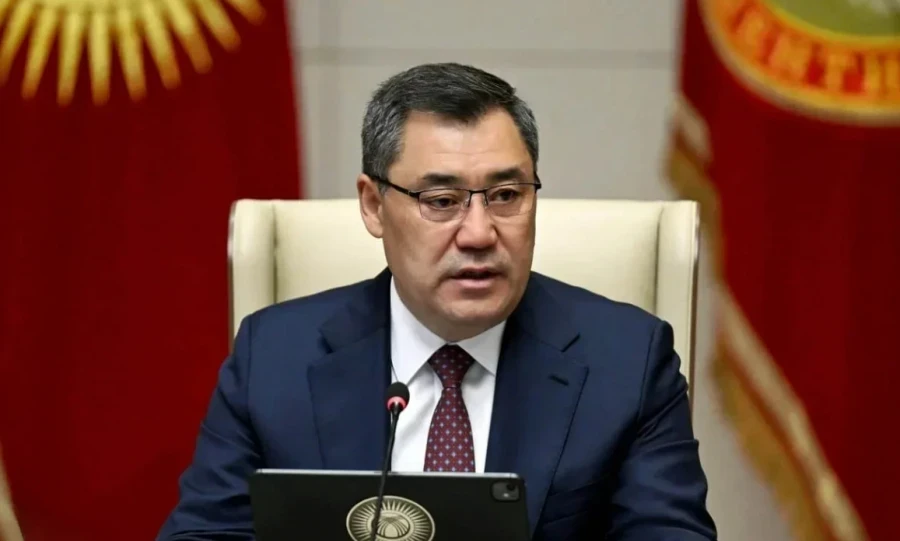
The President noted that the preparation of the reform took quite a long time.
In an interview with the news agency "Kabar," President Sadyr Japarov spoke about significant changes being prepared in the law enforcement sector.
— Hello, Sadyr Nurgozhoevich. Today, I would like to discuss the status of the GKNB as a state body.
Previously, both former leaders and ordinary citizens noted that during Soviet times, no one knew who exactly worked in the KGB. Recently, there have been many complaints about the GKNB, particularly that its employees often display their identification, undermining the authority of the organization. Are you aware of such public opinions?
— Certainly, I am aware. I have raised this issue more than once with one of my friends. I said: "Raise the authority of the GKNB. It should be the same as that of the KGB of the USSR. Otherwise, there are cases where individuals, presenting themselves as GKNB employees, show their IDs even to certain 'kamuks.' Let's put an end to this criticism." I have raised this issue repeatedly.
— We hear about the detention of GKNB employees on suspicion of offenses. Is this related to the excessive power granted to them? The special service has essentially interfered in many areas—from construction violations to regulating meat prices and combating prostitution.
— On the day the video about the "fight against individuals providing intimate services" was released, I called people and said: "Pass this to the Ministry of Internal Affairs; this is their job. Do not lower the level of the GKNB."
As for cases of corruption among employees, investigative actions are currently underway, but I cannot provide details.
— Recently, you excluded the Border Service and the Security Service from the structure of the GKNB. Can you tell us about the planned reform? In what areas will the agency operate? Will it retain the function of combating economic crimes and corruption, or will this responsibility be transferred to another body?
— We are preparing a significant reform of the law enforcement agencies. I wanted to start it earlier, but for various reasons, it was postponed.
Now, I hope that we will begin its implementation in the near future.
The GKNB will focus exclusively on its core tasks: intelligence, counterintelligence, protecting the constitutional order, combating terrorism, extremism, banditry, drug trafficking, and other specialized areas.
Investigative powers on these issues will remain with them. They will not interfere in the economy. No one should know what the GKNB is doing and who its employees are.
After the reform, it will become a full-fledged special service, similar to the former KGB.
The Ministry of Internal Affairs will also operate exclusively within its tasks. They will retain their investigative powers.
A list will be compiled, in which the legislation will define what powers are transferred to whom.
A new Investigative Committee will also be established, which will take over all investigative functions. The General Prosecutor's Office and the Military Prosecutor's Office will oversee the legality of the work.
If you ask why an Investigative Committee is needed, I will answer: we must think about the future and the stability of the system.
What is the current situation?
In the GKNB and the Ministry of Internal Affairs, there are operational investigative activities and investigators, all managed by one minister.
For example, an operative may lead a case that, say, unjustly affects a person, and when the materials are handed over to the investigator, he may decide that the case will not pass through the court. In such a case, the minister can call the investigator and order: "Accept and open a criminal case."
The investigator finds himself in a situation where he is forced to open a case, having no choice.
Thus, it cannot be said that there are no facts of injustice.
The Investigative Committee will report directly to the president. It will be able to reject materials submitted by operatives and ministers and not initiate cases.
Thus, citizens who have become victims of injustice will not be arrested—they will be released immediately. This way, human rights will be respected at least ninety-five percent of the time. This will ensure the safety of future generations.
The same principle will apply to economic cases: if a crime truly occurred—there will be an arrest; if it is slander—the person will be released. Two different bodies, operating independently of each other, will be able to make balanced decisions.
These measures will be implemented in the future. We will prepare the necessary buildings and technical base. A decree will be issued, and the relevant draft laws will be submitted to the Jogorku Kenesh, where they will be discussed and adopted, after which organizational work will begin.
This year, we will hold the SCO summit and the World Nomad Games. Therefore, we will start implementing the reform next year.
Photo www


