
In an interview for "VES 24," Dremuchev spoke about the work of "Rosatom" in Central Asia, including priority areas such as energy modernization and the implementation of environmental initiatives.
Uzbekistan: the first export contract for a small nuclear power plant
- The year 2025 has become an important milestone for "Rosatom" and its international divisions. We have noticed significant changes in the perception of our company both from experts and the population of Central Asia. In particular, in Uzbekistan, public opinion about Russian nuclear technologies is positive, which facilitates our work. The uniqueness of Russian technologies, especially small nuclear power plants, lies in their safety. Vladimir Putin stated at the "World Nuclear Week" that in 2030, the world's first nuclear system with a closed fuel cycle will be launched in the Tomsk region. This raises the question of the application of such reactors at new "Rosatom" facilities in Central Asia.
- You are right, 2025 has become a landmark year: last year our nuclear industry celebrated its 80th anniversary. We honored veterans who take pride in their achievements and continue to expand our horizons.
One of these horizons is the project in Uzbekistan, where we have begun construction of a small nuclear power plant, marking the world's first export contract for such a project.
In May, the production of reactor equipment began, including the casting of a 205-ton ingot made of special steel for the RITM-200N reactor vessel. By October, the construction of the small modular reactor (SMR) entered a key phase: work began in the Jizzakh region to create a pit for the power unit, with an earthworks volume of about 1.5 million cubic meters and a depth of up to 13 meters.
The station based on the RITM-200N reactor stands out for its compactness and efficiency, allowing for shorter construction times compared to larger nuclear power plants. This reactor belongs to the 3+ generation, which means compliance with all modern safety standards, including the ability to ensure uninterrupted heat removal for 72 hours without human intervention.
As for the closed fuel cycle, "Rosatom" is a world leader in this area, developing fourth-generation technologies that enhance uranium utilization efficiency and reduce nuclear waste volumes. The "Breakthrough" project includes the BRSM-300 reactor, which operates on fast neutrons, and we have extensive experience in its operation thanks to the Beloyarsk NPP.
The selected nuclear power plant projects in Uzbekistan will be equipped with VVER reactors, which have proven to be effective and safe.
We always prioritize safety and offer proven solutions to our foreign partners. The regulatory authorities in Russia have issued licenses for the "Breakthrough" project, and we are confident in its effectiveness. However, a decision on its international implementation has not yet been made.
- In the summer of 2025, "Uzatom" and "Rosatom" signed an agreement to build a large-capacity nuclear power plant in Uzbekistan. What are the features of this project and when will construction begin?
- On September 26, at the "World Nuclear Week," we signed an agreement for the implementation of an integrated nuclear power plant in Uzbekistan, which includes two large units based on VVER-1000 and two units with RITM-200N reactors, each with a capacity of 55 MW. This clarifies the agreement reached on June 20 at the St. Petersburg International Economic Forum.
We are currently working on the contract, but I cannot yet provide an exact date for the start of construction. It is better to follow the Eastern wisdom that "haste is from the devil." We will definitely inform you when we are ready.
The integrated nuclear power plant is a unique solution that will provide base load and compensate for peak consumption spikes. When all units are commissioned, the station will be able to cover up to 14% of Uzbekistan's energy consumption, producing about 17.2 billion kWh per year, which is very important considering the projected growth in energy consumption by 1.7 times by 2030.
The safety of the technology is also important: the VVER-1000 reactor, like the RITM-200N, belongs to the 3+ generation and is one of the most reliable today. There are 13 such units operating in Russia, with similar ones in China, India, and Iran.
Nuclear medicine: the future of healthcare
- "Rosatom" and Kyrgyz partners have launched a project to implement nuclear technologies in healthcare. What benefits will this bring to Kyrgyzstan?
- "Rosatom" and the Ministry of Health of Kyrgyzstan have been successfully collaborating in the field of nuclear medicine for several years. We have achieved significant results: after a long hiatus, a nuclear medicine department was opened at the National Center for Oncology and Hematology in Bishkek. We continue to supply technetium generators and radiopharmaceutical kits from Russia, which are necessary for the uninterrupted operation of the clinic. A full nuclear medicine center will be established based on this department, which will improve the diagnosis and treatment of oncological, cardiovascular, and neurological diseases using modern technologies.
This project will benefit not only the citizens of Kyrgyzstan but also residents of neighboring countries.
Wind energy in Kyrgyzstan
- How is the construction of the first wind power station in Kyrgyzstan progressing? What are the principles of Russian companies' approach to "green" energy projects?
- "Rosatom" is actively developing a strategy for producing low-carbon energy, remaining a leader in this field in Russia. We have experience in implementing wind energy projects in the country and are ready to offer solutions for Kyrgyzstan, where wind can become an important energy source.
In the Issyk-Kul region, we are building a wind farm with a capacity of 100 MW. The project is on track, and key components for the wind turbines have already been delivered. Next year, we plan to pour the first foundation.
- What are the environmental aspects of the project to eliminate "tailing storage" in Kyrgyzstan and Tajikistan?
- We believe that nuclear energy is "green." This is even confirmed in Europe, where nuclear energy is included in the taxonomy of sustainable finance. Studies show that nuclear power plants have the lowest indirect CO2 emissions compared to other energy sources.
We strive to ensure that all projects, including uranium mining and station construction, end with environmental restoration. This is an approach we apply in Russia, and we are confident that in the future we will have all the necessary tools for ecosystem restoration.
Training specialists for the "peaceful atom"
- How does "Rosatom" train specialists to work with nuclear technologies, including medicine?
- Training highly qualified personnel is an important part of "Rosatom's" work. We collaborate with the Ministry of Education and Science of Russia and offer training for foreign students in the field of nuclear technologies. A branch of the National Research Nuclear University MEPhI has opened in Tashkent, which has been recognized by the IAEA as one of the best practices. The branch has already graduated 161 bachelor's degree students, most of whom continued their studies in master's programs.
We are also working with Kazakhstan, where "Rosatom" has become the leader of the international consortium for the construction of the first nuclear power plant. This year, engineering surveys began at the site.
Humanitarian projects of "Rosatom" in Central Asia
- We implement numerous scientific and educational activities for students and schoolchildren. Science and nuclear festivals, film screenings, and the "Smart Holidays" program are held in Central Asia, allowing schoolchildren from these countries to visit Russian children's camps.
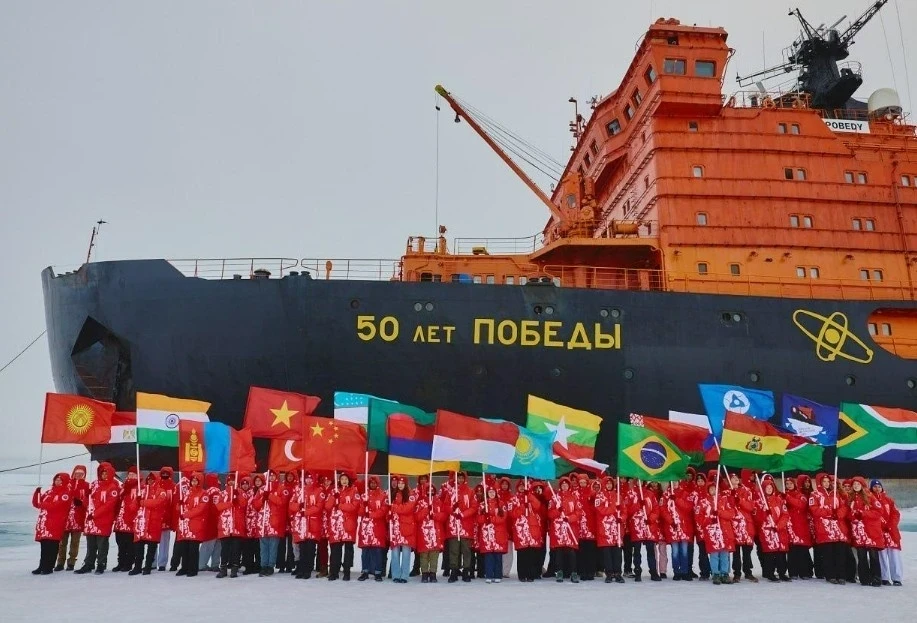
The wonderful project "Knowledge Icebreaker" allowed schoolchildren from Kazakhstan, Uzbekistan, and Kyrgyzstan to travel on a nuclear icebreaker to the North Pole, providing a unique experience of interacting with experts and studying the world's oceans and ecology.


