
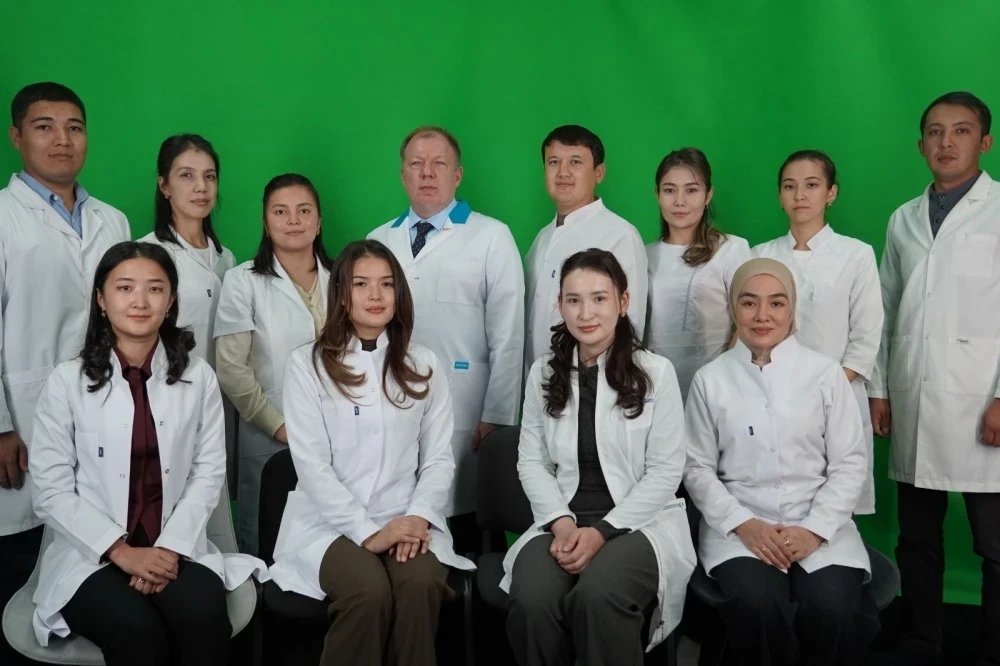
Professor Igor Pershukov, head of the department of hospital therapy at the Medical Institute of Jalal-Abad State University, also conducts distance learning classes at the International Medical Faculty of Osh State University and teaches at the Kazakhstan-Russian Medical University in Almaty. Igor Viktorovich, a renowned scientist who moved to Kyrgyzstan from Russia last year, aims to make Jalal-Abad University known on the international stage.
During our conversation, we discussed what prompted the professor to move to Kyrgyzstan and the basis of his ambitious plans.
"I intend to make JAGU a university that will be talked about on all continents"
- Why Kyrgyzstan? (For me, who grew up in Soviet times, it is pleasant to call your country that). This question is both simple and complex. Kyrgyzstan became an important place for me because almost 30 years ago I met Talant Batyraliev. This person, despite his sternness, turned out to be an incredibly interesting, multifaceted professional and simply a caring person. His ability to unite people inspired me, and I became part of the group of doctors he created in the 90s, working in Turkey and other countries. This group, consisting of cardiologists, continues its activities today. I was its secretary for a long time, and our collaboration allowed me to grow and exchange experiences with colleagues.
Talant is a true patriot of Kyrgyzstan; he trained Russian doctors in Turkey and helped Kyrgyz medical professionals receive education in Russia. Alongside him in this work was Yuri Vladimirovich Pya, who, while working in Turkey, performed about 900 heart surgeries a year and became an outstanding cardiac surgeon. His unconventional approach to surgery became a true revolution in cardiac surgical practice.
Talantbek Batyraliev, as a senior mentor, constantly strived to improve the quality of medicine in the CIS, organizing meetings of doctors and scientists, creating opportunities for education. The knowledge gained from our joint work allowed me to enhance my practice and treatment methods. We began conducting training seminars for doctors in Russia and other CIS countries, where we saw interest in new technologies and methods.
Thanks to my friendship with Batyraliev, I gained access to the American Society of Cardiovascular Angiography and Interventions, becoming the first honorary member from Russia. This is one of the most prestigious associations of cardiologists in the world. In 2012, I also became an honorary member of the American College of Cardiology.
Thus, my work in Kyrgyzstan became a response to Talant's request for help with the education of doctors and students from his homeland. In 2015, I first came to Osh, met with the rector of Osh State University, Professor Kanaybek Isakov, and began systematic cooperation. Since then, I have observed positive changes in the knowledge level of doctors and students. Over the past few years, two of our students have received PhD degrees, and I rejoice in their successes.
In 2025, Talantbek Abdullayevich offered me a position as a lecturer at JAGU, and I gladly accepted. The rector of JAGU, Professor Keneshbek Usenov, suggested I head the clinical department, and at the beginning of the academic year, I started working at Manas, where I already have five graduate students.
JAGU is a dynamically developing university, and its medical faculty shows excellent prospects. We actively collaborate with colleagues from Russia and Kazakhstan, conducting distance lectures, which generate interest among students. My department consists of young and energetic teachers who are eager for development and scientific activity.
How did you become a world-renowned scientist?
- In 1994, I graduated from Kuban State Medical Institute with honors and entered a residency in cardiology. My path in cardiology began in the arrhythmia department, where I was fortunate to work under the guidance of a talented specialist, Irina Savelieva. Later, I continued my education in angiography, and my scientific supervisor was Doctor of Medical Sciences Anatoly Nikolaevich Samko, who became a true role model for me.
After completing my residency in 1996, I entered graduate school and successfully defended my candidate dissertation in 1999. I worked in Voronezh, where over 20 years I gained significant experience and defended my doctoral dissertation in 2004. Since 2010, I have been involved in outpatient cardiology, which allowed me to broaden my horizons.
Since 2017, I have been engaged in cardio-oncology, helping patients undergoing chemotherapy cope with side effects. In 2020, during the pandemic, I was able to quickly adapt and find effective solutions for treating post-COVID conditions.
From 2020 to 2023, I worked solely in private practice, and in 2023, I returned to state angiography while continuing my work in a private clinic.
I have always strived for analysis and improvement of my practice, which allowed me to quickly obtain a doctoral degree at 33 and combine practice with teaching.
Did you choose medicine back in school?
- Initially, I dreamed of becoming a radio engineer, but life forced me to change my plans. Studying medical technology and my interest in the exact sciences led me to medicine. I began my career as an orderly in a maternity hospital, where my first mentor, Boris Grigorievich Yermoshchenko, became an important example of professionalism for me.
With each passing year, I became more interested in cardiology. My path to angiography was accidental, but it was there that I met Talant Batyraliev, who became my friend and ally.
Talant possesses unique qualities that allow him to easily communicate with people and find common ground. His abilities inspired me to continue my work in cardiology.
Together with him, we created the SanKo clinic, which has achieved high standards in cardiac care. My work with him opened new horizons for me.
What is your view on treatment?
- I have my own approach to treatment. I believe it is important not only to apply modern technologies but also to consider the individual characteristics of each patient. I strive to explain patients their problems and involve them in the treatment process.
I educate my patients so that they become "smart" and understand what is happening with their health. This is important because many chronic diseases require constant monitoring and treatment.
I also pay attention to common misconceptions, such as about infusion therapy, which is not always a solution for chronic conditions. It is important to use medications that protect patients every day.
Treating people in Kyrgyzstan is more challenging than in Russia due to limited access to necessary medications, but I try to find solutions and adapt treatment regimens to local conditions.
Unfortunately, health cannot be fully restored, but the risk of complications can be significantly reduced with the right approach to treatment and lifestyle changes.
I am convinced that openness and honesty in communication with patients contribute to effective treatment and help establish trusting relationships.
Why are there so many cardiovascular diseases?
- We have learned to save people from heart attacks, but modern living conditions require quick responses and high stress, leading to early hypertension and other diseases. Alcohol also plays a role, and I believe its consumption should be limited.
I teach young doctors that in case of suspected heart attack, urgent treatment is important, including aspirin, and calling an ambulance. It is crucial for patients to know where to seek qualified help.
Unfortunately, many dietary supplements are ineffective, and I urge caution in their use. We must rely on scientifically proven treatment methods.
What is your attitude towards high technologies in medicine?
- I understand people's caution towards high technologies; this is a problem not only in Kyrgyzstan but throughout the post-Soviet space. It is important to explain to patients the necessity of interventions and ensure openness in communication.
The financial aspect of medical care also plays a significant role. Kyrgyzstan needs to develop a system of free medicine to ensure access to necessary assistance for all citizens.
What is your attitude towards Kyrgyz culture and cuisine?
- I appreciate the openness and sincerity of Kyrgyz society. I enjoy the holidays and traditions that exist here, especially the attitude towards children. However, I am concerned about the lack of road behavior culture and frequent power outages.
The cuisine is interesting, but it doesn't quite suit me in terms of calorie content. I prefer a Mediterranean diet but enjoy local nuts and dried fruits, which I consider healthy.
Do you have new dreams and plans?
- I want to make JAGU a university that will be known beyond Kyrgyzstan. We are already working on creating a world-class cardiovascular center, and I hope this will become a reality.
Elena Bayalinova,
media expert on health issues.


