
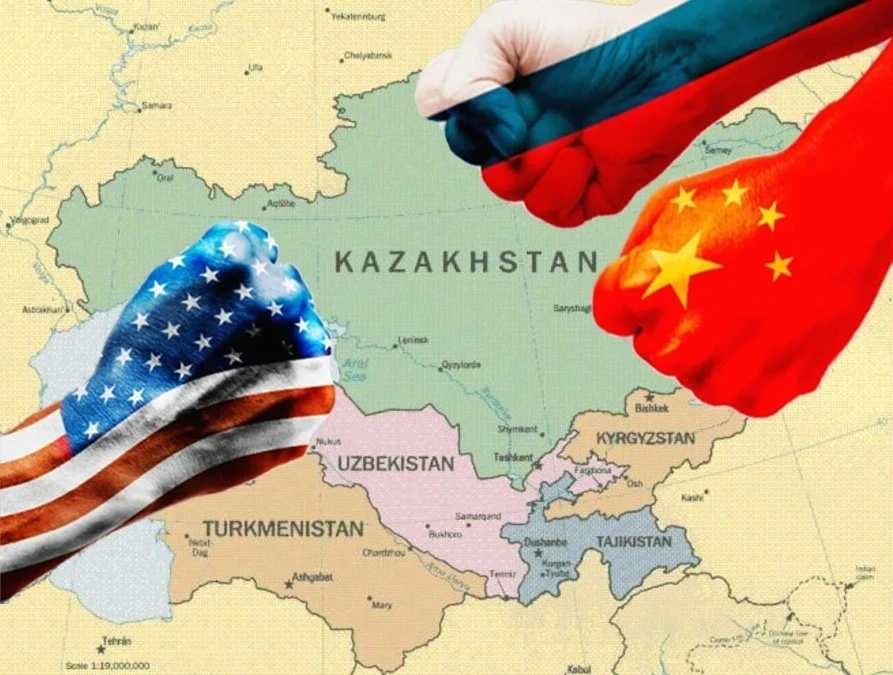
At a round table dedicated to global trends in Central Asia, held under the title "Global Trends in Central Asia: From Security Provision to Extraction of Critical Minerals," experts noted that the role of international law in current events has significantly weakened.
The director of the Center for Expert Initiatives, Igor Shestakov, emphasized that the beginning of 2026 has become a landmark for world politics. According to him, "the kidnapping of Venezuelan President Nicolás Maduro by American military forces is a new method of Donald Trump's foreign policy. This case confirms that international norms have lost their relevance and remain only on the pages of textbooks. The forcible removal of Maduro in collaboration with local elites has allowed the U.S. to gain control over the largest oil and gas reserves without any costs for military actions."
Shestakov also expressed concern about the fate of investments from China ($50 billion) and Russia ($15 billion) in the Venezuelan economy, which are now at risk. He noted that the region's resources, including Central Asia, are once again becoming a battleground between great powers. "We have repeatedly warned that the confrontation between the U.S. and China will affect our region. Washington needs to maintain its leadership without relying on China for critical raw materials. Therefore, the government and the Jogorku Kenesh must develop legislation that benefits our country, not the U.S.," he added.
Murad Musabaev, a systems analyst, agreed that current global trends require analysis in the context of property redistribution. "The U.S. is becoming the 'United States of the World.' In anticipation of the expected stock market crash in 2029, investment funds are eager to transfer their assets into more stable forms, such as gold and land. They clearly understand what they want from us and are actively imposing their conditions," he noted.
According to Musabaev, scenarios similar to that of Venezuela are part of a broader plan by transnational corporations to seize resources. "Soon this icebreaker will crack, and when macroeconomic zones are created, we must clearly know who we are left with. Our alternative should definitely not be in the face of Washington or London," concluded the analyst.
Anara Dautalieva, head of the NGO "Taza Tabigat," raised the issue of resource sovereignty, reminding that according to legislation, subsoil resources belong to the people. "Preserving resources for future generations should be our priority. In the future, safer technologies will emerge. We cannot completely shut down mining, but our resources should benefit the people, not just foreign investors," she stated.
As an example, she cited the situation with "Kumtor," where a foreign company repeatedly violated environmental standards and did not pay royalties. "The paradox is that ordinary citizens pay taxes even for drinking water, while Centerra, which made huge profits, has not paid a single tyiyn," Dautalieva expressed her outrage.
Arkadiy Rogalskiy, executive director of the Kyrgyz Society of Subsoil Experts, confirmed that information about the industry's revenues is becoming more accessible; however, it is necessary to improve the transparency of development fund expenditures. He highlighted waste management as a key task. "Most resources are not in primary deposits but in tailings. We have 123 hazardous sites registered with the Ministry of Emergency Situations and about 400 unaccounted dumps. Starting work with the inventory and processing of tailings is the first step towards effective management of critical materials," Rogalskiy believes.
Almaz Nasirov, director of the Institute for Strategic Analysis and Forecasting at KRSU, noted that the new race for resources is changing Central Asia's status from the periphery to a key position in the global economy. "This is not just an economic issue but a geo-economic one. The transition to 'green' energy has significantly increased demand for our minerals. However, small countries like Kyrgyzstan face technological limitations. We need to develop a quality investment model to avoid situations where a project does not initially meet the country's interests. Having resources is only half the battle; it is important to understand how ready we are to integrate into global supply chains and what benefits we can extract," Nasirov concluded.
The event was organized by the Center for Expert Initiatives "Oy Ordo" in collaboration with the Council for Sustainable Development in the Context of Climate Change under the Speaker of the Jogorku Kenesh of the Kyrgyz Republic.


