
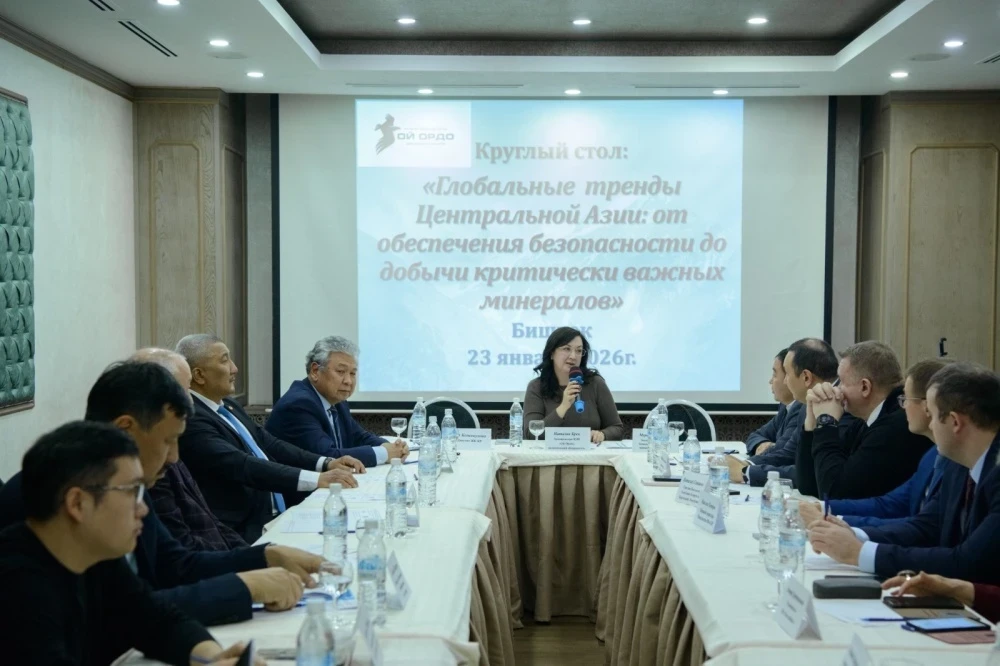
The questions of economic prospects for Central Asia in the context of global geopolitical instability and international competition for non-renewable resources became the central theme of a round table organized by the Economic Research Center "Oiy Ordo" in collaboration with the Council for Sustainable Development in the Context of Climate Change under the Speaker of the Jogorku Kenesh of the Kyrgyz Republic.
Deputy Director of the Economic Research Center "Oiy Ordo" Natalia Kreck emphasized that 2023 has already brought a number of unexpected geopolitical events, such as the situation in Venezuela and the active actions of the European Union regarding Greenland. According to her, this highlights the growing competition for resources, in which Central Asian countries, rich in uranium and other critically important minerals, are undoubtedly involved.
Kreck drew the participants' attention to a report by the rating agency S&P Global Platts, prepared in November 2025. According to this report, the USA intends to continue investing in the exploration and extraction of minerals in Central Asia; however, the implementation of these plans will face serious challenges.
Among the issues mentioned in the report are logistical difficulties related to the influence of Russia and China on the region's transport infrastructure. Additionally, the governments of Central Asian countries will try to avoid actions that could provoke a negative reaction from Moscow and Beijing.
The launch of many planned mining projects in the USA will take a long time, and their success will depend on stable foreign financing, effective energy supply, and logistics. However, low levels of investment, corruption, and poor governance may slow down these processes.
The extraction of critically important minerals requires significant energy resources, and the lack of electricity, especially in the southern region, is exacerbated by climate change, negatively affecting river flow. The declining level of the Caspian Sea may also impact port capacity, necessitating costly investments in infrastructure.
Analysts also point to risks associated with authoritarian governance in the region. The absence of clear mechanisms for power transfer and the suppression of democratic institutions may lead to economic crises and social unrest. Experts believe that the resolution of the conflict in Ukraine could allow Russia to regain its positions in Central Asia, which would weaken US influence.
Washington, however, seeks to create competition between Kazakhstan and Uzbekistan, which, according to American analysts, may slow down the establishment of a unified economic bloc in the region. It is important for Central Asian countries to approach investment cooperation carefully to avoid geopolitical traps and maintain sovereignty over their resources.
Former Deputy Foreign Minister of Kyrgyzstan Avazbek Atakhanov noted that the issue of critically important minerals is not new. He stated that during the Soviet era, they were referred to as rare earth metals, and with scientific and technological progress, interest in them has only increased. Kazakhstan, as a leader in uranium production and export, has significantly succeeded in this area, and Kyrgyzstan should pay attention to its reserves.
Chairman of the Association of Geologists and Mining Industry Workers of Kyrgyzstan Duyshenbek Kamchybekov also emphasized that the country has significant mineral reserves; however, many of them are still at the level of forecast estimates. He noted the need for a systematic approach to the development of the mining sector so that Kyrgyzstan can effectively utilize its resources.
Kamchybekov pointed out the importance of thorium, which is more efficient compared to uranium. To develop this resource, it is necessary to revise mining legislation to align it with state interests and attract investors.
Deputy of the Jogorku Kenesh Gulya Kozhokulova also highlighted the significance of critically important minerals in the international agenda. She warned against geopolitical traps in resource extraction, citing lessons learned from the situation with "Kumtor." Kozhokulova called for the creation of a strategic program reflecting Kyrgyzstan's interests to avoid repeating past mistakes.
In conclusion, she noted that Kyrgyzstan should focus on training qualified personnel and environmental control to ensure the sustainable development of its resources.
The importance of the legislative framework was also emphasized by Kozhokulova, who proposed discussions with experts to identify necessary initiatives in the industrial sector. This will help deputies better understand and address the pressing issues facing the country.


