
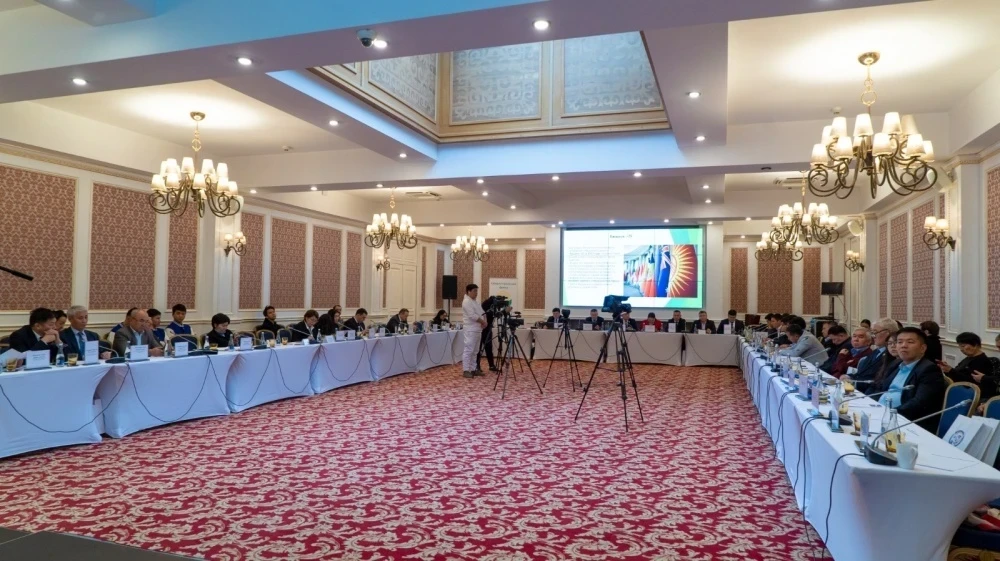
In Bishkek, a conference titled "Water, Mountains, and Glaciers of the Kyrgyz Republic. Sustainable Future" was held, discussing issues related to the country's water and energy security. The event was organized by the J. Balasagyn Kyrgyz National University, the Green Energy Public Foundation, the Oi Ordo Center for Environmental Initiatives, and the Green Alliance of Kyrgyzstan. The main goal of the conference was to promote Kyrgyzstan's interests as a key mountainous state in the region and a supplier of fresh water, as well as to create a platform for regional dialogue on water and climate issues.
Almaz Musaev, the Deputy Minister of Natural Resources, Ecology, and Technical Supervision of the Kyrgyz Republic, noted that Kyrgyzstan is a landlocked mountainous country with an area of 199,900 sq. km, which accounts for only 0.13% of the total land area on the planet. At the same time, the republic is among the 200 priority ecological regions of the world, home to about 2% of the world's flora and 3% of its fauna.
Musaev emphasized that mountain ecosystems play a crucial role in forming unique climatic conditions and serve as a refuge for rare animal species. They provide vertical zonation that varies from desert steppes to alpine meadows and nival zones, making them the core of the country's biodiversity. Glaciers in Kyrgyzstan are a key reservoir of fresh water, meeting the needs for drinking water, irrigation, and energy. In 2024, glaciers and snowfields will be included in the list of specially protected natural areas protected by law.
According to the official, on March 1, 2022, a Roadmap for the Year of Protection of Mountain Ecosystems and Climate Resilience was approved, and a national campaign called "Green Heritage" was launched. In 2023, the Cabinet of Ministers adopted a new decree aimed not only at the successful implementation of "Green Heritage" but also at ensuring environmental safety, improving the environment, preserving forests for future generations, and preventing the negative consequences of climate change and increasing green spaces.
Furthermore, Musaev reminded that Kyrgyzstan initiated the global summit "Bishkek+25" in 2027, which will be an important milestone in the international agenda of mountainous countries. The summit is expected to discuss key issues such as glacier melting, climate change, and biodiversity loss, as well as develop new international solutions to strengthen cooperation among mountainous states.
Professor and Doctor of Economic Sciences Guras Japparov highlighted the complexities of the economic assessment of water resources in Central Asia. He noted that there are many approaches to pricing water resources, and experts believe that water, as a natural resource, should have its price. In some cases, a fee is charged for water use, including compensation for costs related to hydraulic structures and ecosystem services.
Japparov also pointed out the existence of successful examples of transboundary cooperation in the water sector, but noted that in some cases this cooperation is accompanied by conflicts. Chinese expert Liu Qing added that for the rational distribution and effective use of water resources, it is necessary to implement market mechanisms, such as the establishment of a water market.
In his opinion, the price of water should be formed taking into account demand and the full cost of water supply, including maintenance costs. As studies of the water codes of downstream countries have shown, water is both a service and a commodity, but when using water from transboundary rivers, it is perceived as a "Divine gift."
To address the issues of economic mechanisms for regulating the water-energy sector in Central Asia, it is necessary to consider the current situation. For instance, the Toktogul Reservoir operates in an energy mode, and most of the water is released in the fall and winter for electricity generation, while irrigation is needed during the growing season. The impact of climate change, the increase in electricity consumption, and the absence of a regional electricity market should also be taken into account.
Economic analysis shows that for regulating the flow of the Toktogul Reservoir during the growing season, compensation can be estimated at $32.5 million based on 0.65 billion kWh at a price of $0.05 per kWh. This will help preserve water reserves and avoid critical depletion levels.
Japparov also suggested considering the introduction of the term "interstate water reserve" for reservoirs of multi-year regulation, which would allow the reservoir owner to receive payment for water supply services.
According to him, since 2010, there has been a constant increase in electricity consumption and prolonged low-water cycles, leading to a decrease in the volume of water in the Toktogul Reservoir. As a result, in 2014, Kyrgyzstan became a net importer of electricity.
It is important to distinguish between countries regulating river flows, transit countries, and consumer countries, as well as the need to address issues with the participation of all countries involved in water-energy cooperation. This requires the development of specific mechanisms and the continuation of dialogue at the Central Asian level.
Earlier, the rector of J. Balasagyn Kyrgyz National University, Doctor of Geographical Sciences, Professor Dogdurbek Chontoев pointed out that the lack of economic principles in interstate water use is a serious problem for both Kyrgyzstan and the entire Central Asia. He emphasized that the countries of the region, by introducing fees for water supply services for domestic users, do not take into account the market mechanism, which poses a threat to all countries located in the river's lower reaches.
Chontoев also noted that reliable operation of interstate hydraulic structures requires cooperation among all states to ensure stable water supply.


