
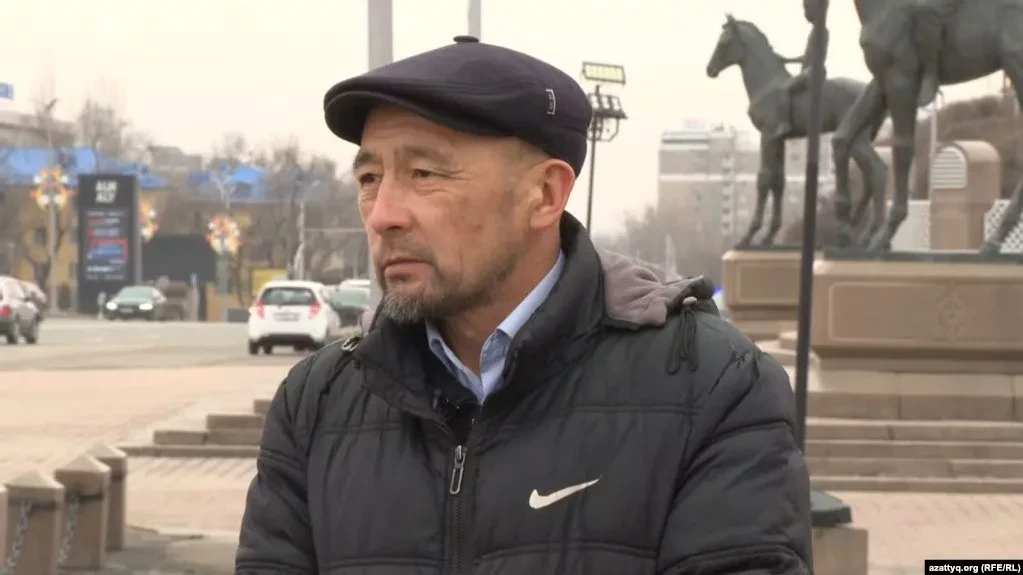
In Almaty, five men of pre-retirement age are on trial, accused of attempting to "seize power" and "organizing mass riots." The investigation claims they planned an attack on the presidential residence. This is not the first case in Kazakhstan related to accusations against activists of preparing an attack on the Akorda. Azattyq Asia delved into the details and spoke with the defendants' lawyers.
The trial is taking place in the Almalinsky District Court, where Kaysar Ozbek, Talgat Ashirov, Askar Nurmagan, Abduali Tagai, and Duyssenbek Zhakashev are on trial. They were detained in June 2025 and have since been held in the detention center of the National Security Committee. Court sessions began in early February and are being held behind closed doors.
At the last session, held on February 25, Talgat Ashirov felt unwell, and the proceedings were postponed to February 27.
WHO ARE THESE DEFENDANTS?
57-year-old Askar Nurmagan, a civil activist from Karaganda, actively participated in protests in support of Ukraine and against migrants from Russia. Last year, he was arrested for 15 days for obstructing a march with the Soviet flag on May 9. In 2021, he was already subjected to criminal prosecution and sentenced to one and a half years of restriction of freedom for participating in banned movements.
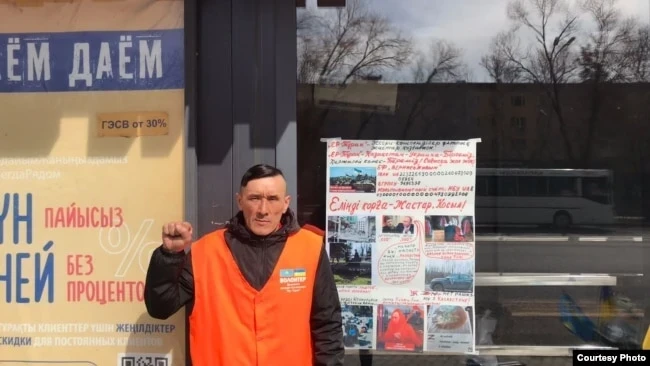
Activist from Karaganda Askar Nurmaganov during a rally in support of Ukraine
58-year-old Kaysar Ozbek, an activist from Almaty, also expressed his views on political events. In January 2022, he was among those protesting against the deployment of CSTO troops. Later, he recounted witnessing soldiers opening fire on unarmed citizens.
57-year-old Abduali Tagai from Astana was active in 2016 during the "land rallies," which led to a moratorium on changes to the land code. He was also detained after anti-Chinese protests in 2019.
There is no information in open sources regarding 62-year-old Talgat Ashirov and 56-year-old Duyssenbek Zhakashev. Four of the defendants were unemployed before their detention, while Kaysar Ozbek worked as a driver.
ESSENCE OF THE ACCUSATION
Askar Nurmagan, Abduali Tagai, and Duyssenbek Zhakashev are accused of promoting the seizure of power and organizing mass riots. Kaysar Ozbek and Talgat Ashirov are also accused of illegal handling of weapons. The investigation claims that Ozbek openly expressed intentions to seize power and discussed plans with other defendants.
According to the investigation, during the winter of 2025, the accused were developing plans for organizing mass riots, including the seizure of the presidential residence. They also considered issues of financing and accommodating participants in the riots.
The case materials indicate that on April 27, 2025, they conducted reconnaissance of the presidential residence, and in May, they purchased radios and loudspeakers. In early June, the investigation claims they prepared Molotov cocktails and acquired explosive devices.
On the night of June 15, a cache of Molotov cocktails and weapons was found in the Iliysky district.
The case materials also mention a certain Umarbekov, who is not a defendant, but whose role remains unclear. The investigation believes that the actions of the defendants could provoke negative attitudes toward the authorities and incite protest actions.
DEFENSE ATTORNEYS' OPINIONS
The lawyers representing the defendants assert that the accusations are unfounded and lack factual support.
Ghalym Nurpeisov, the defender of Abduali Tagai, emphasizes that organizing mass riots requires resources that his client does not possess. He believes the accusation is based on provocation.
“Mass riots require serious organization. These people are ordinary workers, and I do not see how they could organize such a movement,” says Nurpeisov.
Janara Balghabaeva, the lawyer for Askar Nurmagan, believes that her client did not commit any crimes and became a victim of provocations.
“Law enforcement agencies infiltrated provocateurs who pushed activists toward destructive actions. My client was unaware of such actions and did not participate in them,” she asserts.
Balghabaeva also points out that Nurmagan did not participate in the discussions attributed to him in the case materials.
COMPARISON WITH OTHER CASES
The lawyers mention other cases where similar accusations of attempts to seize the Akorda were made. For example, last August, a court sentenced five men to four years of restriction of freedom for attempting to organize riots during a referendum on a nuclear power plant.
One of the high-profile cases is related to the "tractor case," where six activists were convicted for attempting to seize power. This case also involved hidden video recordings and testimonies from secret witnesses.
Evgeny Zhovtis, a human rights defender, noted that the new case of seizing the Akorda raises questions, as there are no clear signs of organizing mass riots. The defendants are not well-known figures capable of bringing people out onto the streets.
Zhovtis emphasizes that there is a trend in Kazakhstan to persecute not only protest leaders but also groups of activists, reminiscent of Soviet times when gathering more than three people was prohibited.
The trial is being held behind closed doors, which raises doubts about the transparency and independence of the judicial system.
The lawyers also believe that there are no grounds for closing the proceedings, as is happening in this case of "seizing power" and "organizing mass riots."


