
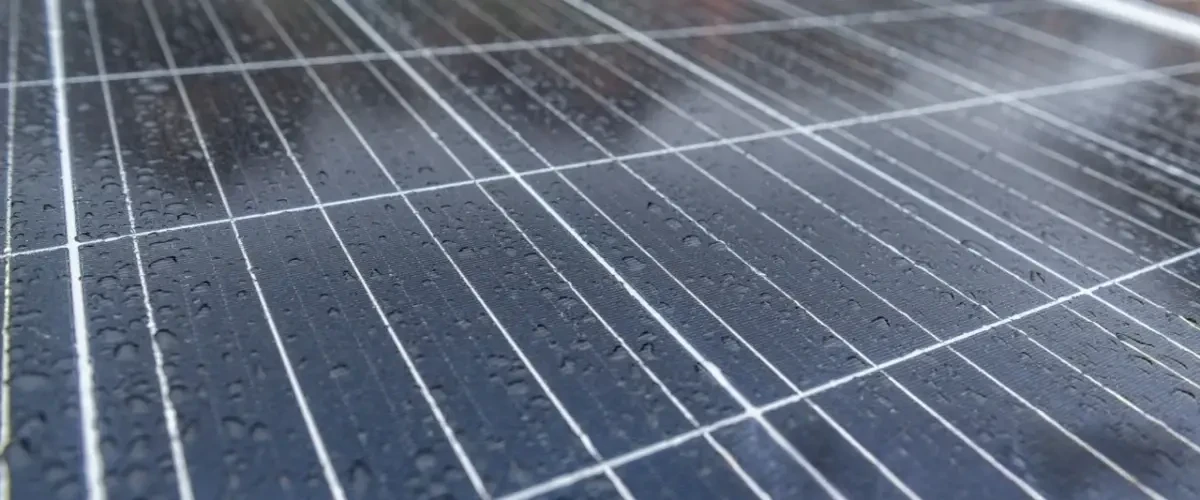
The problem of reduced solar panel efficiency in cloudy weather has been solved by a team of scientists from Spain who developed a device that generates electricity from both sunlight and raindrops. This innovation opens new horizons for powering various Internet of Things devices and external sensors.
The film created by the scientists, which is less than 100 nanometers thick (for comparison, a human hair has a diameter of about 80,000 nanometers), serves two functions: it protects the chemical structure of perovskite cells and increases light absorption, while also acting as a triboelectric surface that converts the kinetic energy of raindrops into electricity. In experiments, a single raindrop was able to create a potential difference of up to 110 volts, which is sufficient to power small portable devices. This is particularly relevant for areas with long rainy seasons, where traditional solar panels lose their efficiency. The device can also power LEDs even when submerged in water and is adapted to fluctuations in temperature and humidity, as reported by IE.
“Our research demonstrates the possibility of integrating perovskite solar cell photovoltaic technology with triboelectric nanogenerators in a thin-film configuration,” noted Carmen Lopez.
This film not only protects the sensitive perovskite elements but also allows for energy extraction from various environmental sources, paving the way for the creation of hybrid solar-rain panels. Potential applications include powering sensors on large infrastructure projects such as bridges, meteorological devices for precision agriculture, and various Internet of Things devices.


