
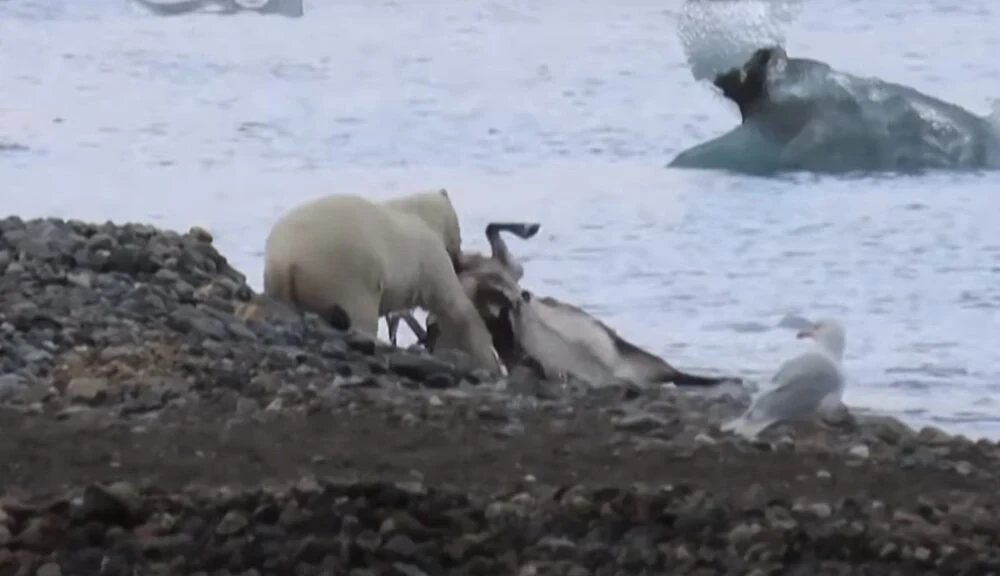
The polar bears of Svalbard have demonstrated an astonishing ability to adapt to climate change associated with melting ice. Although biologists do not yet understand all the mechanisms of this adaptation, research results have already been published in the magazine "Around the World".
These giant mammals are a vivid example of how climate change affects wild ecosystems. Polar bears depend on Arctic sea ice for hunting and breeding; however, its area is rapidly decreasing due to global warming.
Nevertheless, as researchers from the Norwegian Polar Institute have discovered, some populations of polar bears living near Svalbard in the Barents Sea have proven to be more resilient to these changes than expected. These conclusions were based on data collected over 24 years, from 1995 to 2019, and published in a paper in the journal Scientific Reports.
During the study, scientists periodically tracked the bears using helicopters and temporarily immobilized them to assess their physical condition, measured by the Body Condition Index (BCI). In total, more than a thousand assessments of the condition of 770 polar bears on Svalbard were conducted, where a sharp reduction in sea ice has been observed in recent years. By 2019, the ice season in this region had become shorter by more than two months compared to 1995.
According to available data, even in conditions of decreasing sea ice, the health of the bears did not deteriorate. The lead author of the study, Jon Aars, notes that polar bears were in "fairly good" condition, even recovering from a decline in BCI between 1995 and 2000, which was a surprise for him and his team.
However, this does not mean that the bears have completely escaped the consequences of climate change. Some of them have changed their habitats or moved northward, following the retreating ice, Aars explains. It is also difficult to say whether the polar bears could be in better condition without climate change.
While observations of bears in Svalbard may be useful for studying other regions with similar ecosystems, Aars emphasizes that this does not guarantee that all polar bears in the Arctic are in equally good condition.
But what makes the bears in Svalbard so successful? Aars and his team suggest that it may be related to changes in their diet. Due to the reduction in ice area, hunting seals may have become more accessible, and the bears may have started to feed more frequently on the carcasses of walruses or reindeer.


