
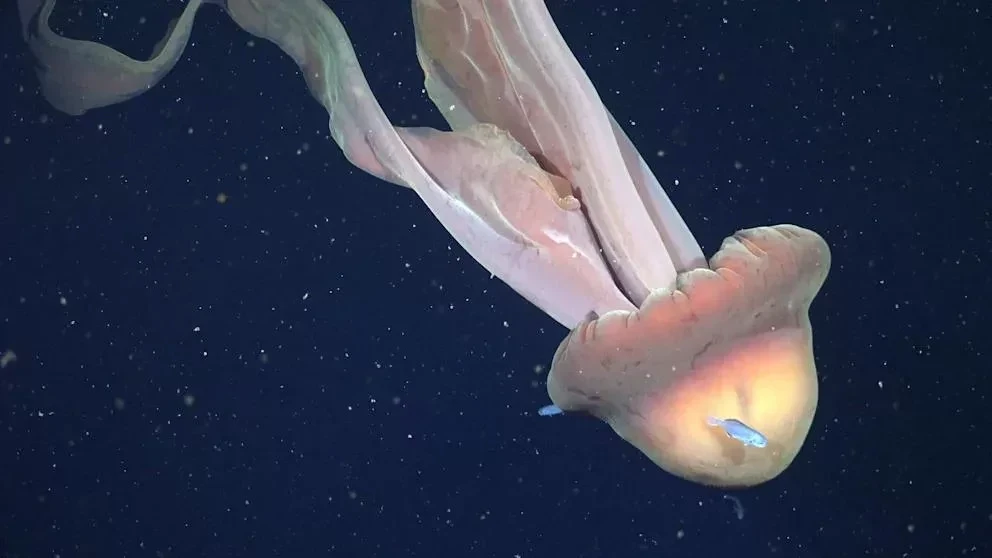
Recent research off the coast of Argentina has yielded an astonishing find: a giant jellyfish known as Stygiomedusa gigantea, the size of a bus, was captured by an underwater camera. The footage was taken from the research vessel Falkor at a depth of about 250 meters during a journey from Buenos Aires to Tierra del Fuego.
Experts from the Schmidt Ocean Institute assessed the jellyfish's size as comparable to that of a small bus, with its tentacles potentially reaching lengths of up to ten meters.
This video has sparked significant interest: such jellyfish are extremely rare, and much of the ocean depths remains unexplored. In addition to the impressive footage, the research team also discovered several coral reefs and possibly up to 28 new species of animals, including worms, snails, and sea anemones.
The expedition covered the entire coastline from Buenos Aires to Tierra del Fuego, traveling approximately 3,000 kilometers. During their research, the team documented the largest known coral reef in the world's oceans and identified 28 potentially new species, including worms, corals, sea urchins, and anemones.
“We were amazed by the level of biodiversity in the Argentine depths, and seeing such life was incredible,” commented the lead scientist of the expedition, Maria Emilia Bravo from the University of Buenos Aires.
“Observing the ecosystems and the relationships between different species was an amazing experience. We opened a 'window' into the biodiversity of our country, but there is still much research ahead,” she added.
The coral reef, the size of Vatican City, is home to numerous organisms, including fish, crustaceans, and octopuses. It is located in the southwestern part of the Atlantic Ocean, with the largest sections found in Argentine waters.
This creature, with tentacles up to 10 meters long and a dome about a meter in diameter, was swimming at a depth of about 250–300 meters. In the last 100 years, there have been only about 100 recorded encounters with this jellyfish species. The phantom jellyfish is a deep-sea predator that is extremely rarely seen by researchers.
Although there was previously little information about this area, the expedition revealed its impressive size. For example, the team discovered coral reefs 600 kilometers south of previously known locations, at a latitude of 43.5 degrees south.


