
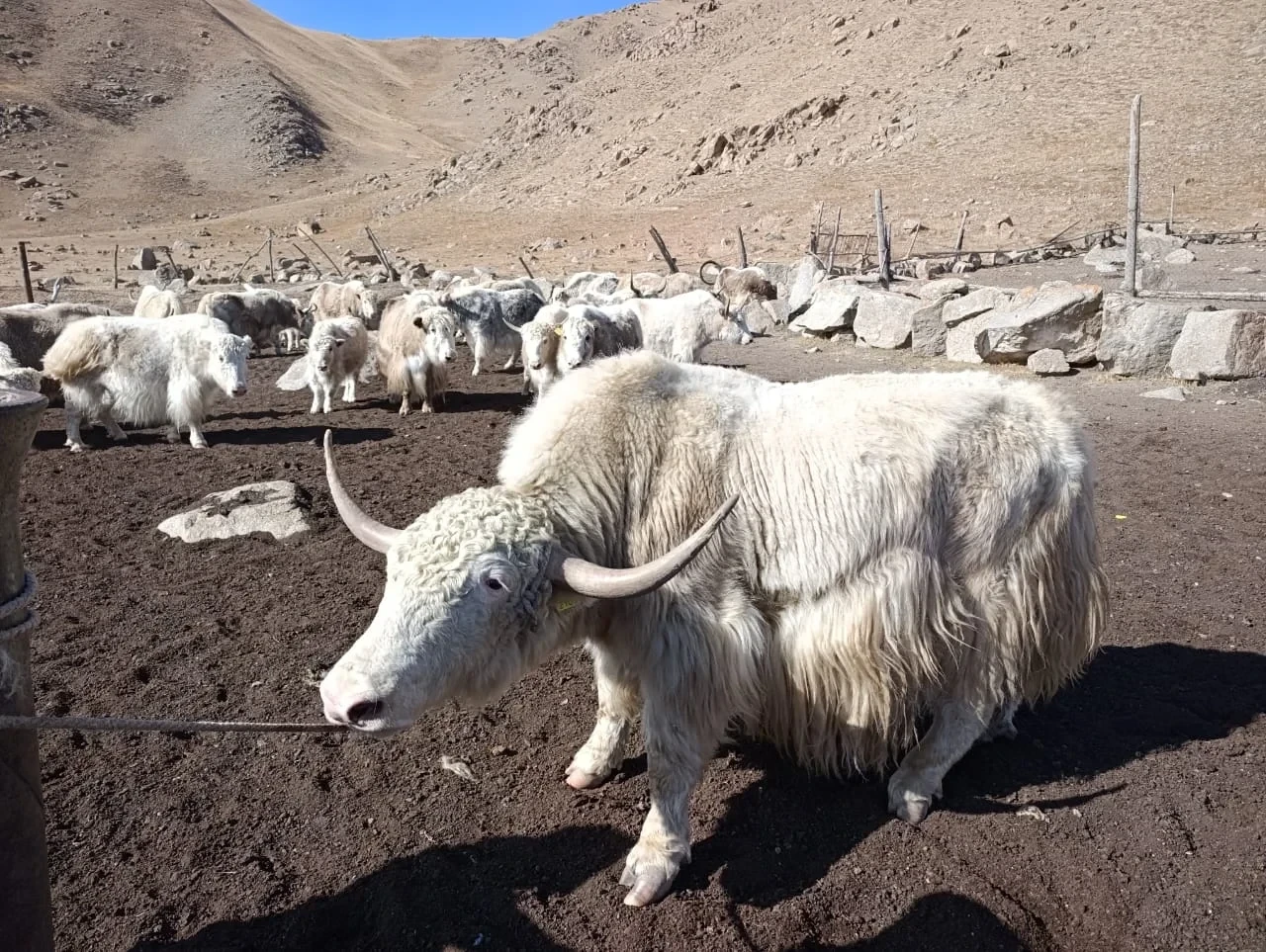
Yaks are distinguished by their high adaptation to cold and arid conditions, making their breeding particularly relevant in the context of climate change. The Ministry of Water Resources, Agriculture, and Processing Industry views them as a promising direction, as they can live and reproduce at altitudes from 2000 to 4500 meters above sea level, where regular livestock cannot survive.
Yak breeding plays an important role in regions affected by climate change and land degradation, such as erosion and loss of vegetation. Yaks can utilize remote high-altitude pastures, which reduces pressure on primary grazing lands.
Currently, research is being conducted with the participation of scientists from the National Academy of Sciences and the Kyrgyz Research Institute of Animal Husbandry and Pastures. The established working group conducts its activities at the "Jaiçy" farm named after T. Akmatov in the Ton district, where the selection of white yaks is being tested.
Farmers Baatyrbek and Tashtanbek Akmatov, who have been breeding white yaks since 2003, have achieved significant success. In 2025, at the "Agrodialog–2025" forum organized by the Ministry, Baatyrbek was awarded the title of "Champion" for white yak breeding, which contributed to increased interest in this direction among farmers.
The Ministry plans to continue its work on developing yak husbandry, supporting breeding programs and farmers.


