
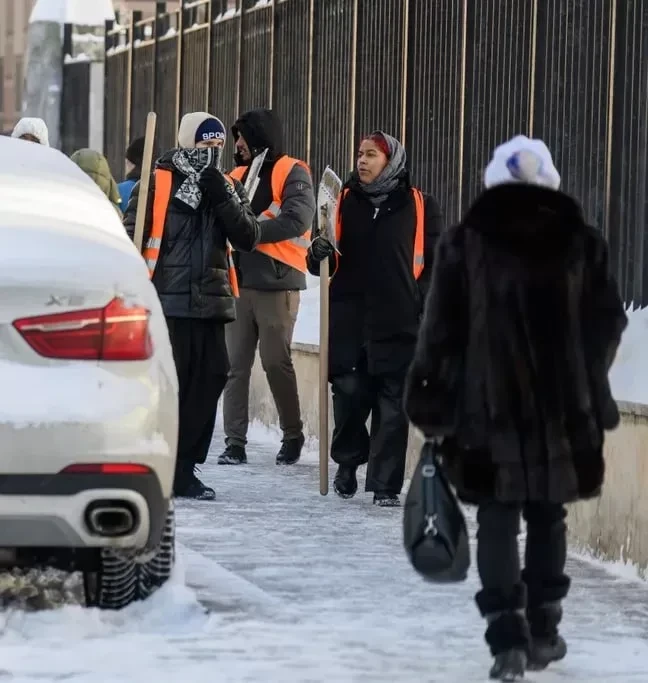
The problem of labor shortages in Russia is becoming increasingly acute. In the capital, snow is now cleared by Cuban migrants who work for low wages, while for other foreigners, the economic situation in Russia no longer seems so attractive.
Dolores, a 29-year-old Cuban woman, tightly grips a shovel as she clears snow from the sidewalk in one of Moscow's alleys. She steps back to let passersby through, who navigate the thin layer of snow under the January sun, and then resumes her work.
Passersby take notice of her: an elderly man in a fur hat looks at her with curiosity, while a young woman in a long coat avoids eye contact and quickly walks past, leaving Dolores, her husband Carlos, and other Cubans who are laboring to combat the snow and ice.
Dolores feels a sense of vulnerability and prefers not to reveal her real name, fearing trouble with local authorities. She refers to herself as an "illegal," having come to Russia as a tourist, which makes her work in the country unlawful.
She recounts that she has faced police threats multiple times simply for "not looking Russian." Racism in Russia is a common phenomenon: a taxi driver, upon seeing the Cubans, jokes, "We already have black people clearing snow," to which he cannot find an answer as to who should be clearing the streets.
The labor shortage in Russia continues to grow. In 2024, according to official data, the shortage of workers exceeded two million people. Moscow Mayor Sergei Sobyanin mentioned a lack of up to 500,000 workers in various sectors.
This creates serious problems for the authorities, especially considering that in the early years of the war with Ukraine, Russia boasted a historically low unemployment rate of 2.2%. However, the country is becoming less attractive for labor migrants, especially from the Muslim republics of Central Asia.
The situation is exacerbated by the risk of being drafted into the war and the falling ruble, resulting in migrants' incomes decreasing by about a third.
Frequent raids and detentions of Tajiks, Uzbeks, and Kyrgyz have become commonplace. Traditionally, they make up the majority of migrants—over three million—employed in construction, restaurants, and the service sector.
Since 2024, the rules for migrants have tightened: police can deport foreigners without a court order, and a registry for "illegals" has been introduced, which denies them access to banking services. It is unclear how and why people end up on this list, and often it affects even those with valid documents.
This winter, Moscow particularly needs workers like Dolores. At the end of January, the city faced the heaviest snowfall in over 200 years. Streets have to be cleared manually and with machinery at temperatures around minus 15 degrees.
Cubans seem to have an informal status that allows them to work in Russia without a visa. The ties between Moscow and Cuba remain strong since the USSR era when Russia supported its ally politically and financially. Nevertheless, Cubans are not immune to harassment.
For their snow-clearing work, they earn about 3,000 rubles a day, sometimes more—by 200 to 500 rubles. Earnings for other types of work, such as in warehouses, are significantly lower—around 2,000 rubles a day.
On this January day, Dolores expects to earn 3,500 rubles for her work—about 45 dollars. This is a significant amount for her, especially considering that in Cuba she earned only about 40 dollars a month, if she could find work at all.
Four other Cubans confirm that in Moscow they can earn more in one day than in an entire month back home, where electricity and internet are often cut off.
Gabriel, a 32-year-old native of Havana, has been living in Moscow for a year. He works every day but cannot get used to the cold conditions. In Havana, the temperature is currently around 16 degrees, which is 30 degrees warmer than in Moscow. Gabriel tries to cover his face with a scarf.
He has boots, while other Cubans only have sneakers. He works up to 12 hours a day with a break for lunch. He does all this for his one-year-old son and sick mother in Cuba.
The exact number of Cubans in Russia is unknown. It is estimated that there are several thousand legally, but there are also illegals like Gabriel and Dolores. The Facebook group "Cubans in Moscow" has 14,000 members, and most of them speak Russian only to a minimal extent.
The hopes of Cubans for obtaining work permits, like the Indians whom Russia plans to attract by the tens of thousands this year, are virtually non-existent. "We are at the bottom of the chain," says Dolores.
A Cuban with legal documents found her a job, having received an order from an Uzbek with a work permit hired by the city administration. Other Cubans, entering the local administration, confirm similar stories, hoping to warm up a bit.
"Work, work, sleep, work, work"—this is how the Cubans SPIEGEL spoke to describe their lives in Moscow. They try to avoid attention and go outside as infrequently as possible.


