
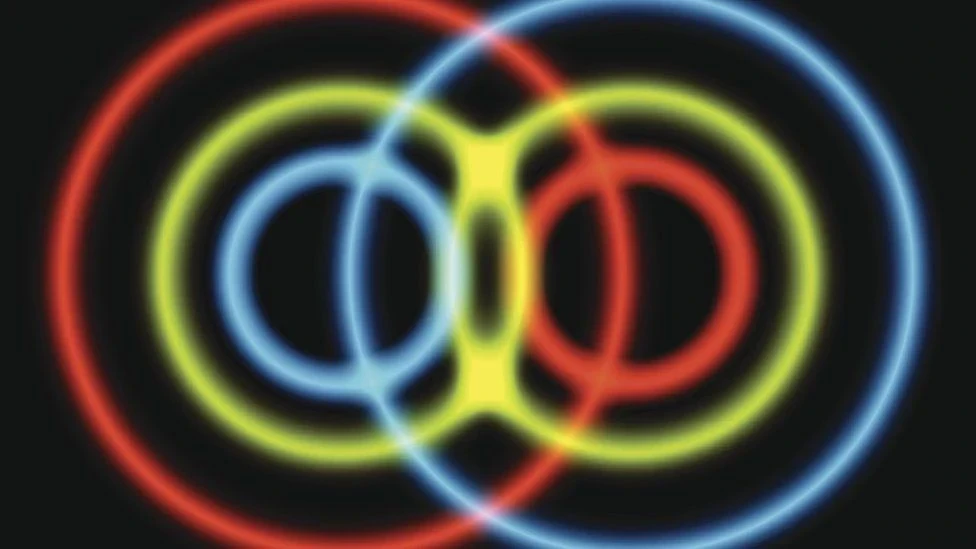
The concept of the multiverse implies the existence of many parallel worlds with different physical characteristics. As reported by ScienceNews, this idea is valuable to physicists not only for its exciting narratives but also because it may shed light on key mysteries of the structure of the Universe.
One such theory is related to cosmology and the period of inflation that began shortly after the Big Bang. At this moment, the Universe was expanding at a colossal speed, and quantum fluctuations were stretching to cosmic scales. In the part of the Universe that we can observe, these fluctuations became the foundation for the formation of galaxies. However, beyond our cosmic horizon, which we cannot see, these fluctuations could have created regions of space with completely different properties.
Physicist Andrei Linde from Stanford University suggests that in such regions, different values for particle masses and different behaviors of fundamental forces may occur. For example, electrons could be significantly heavier, and the laws of gravity could be different. In most of these worlds, life is likely impossible. At the same time, inflation may not have occurred everywhere, suggesting that new "bubbles" of space—separate universes with unique parameters—continue to form in the Universe.
This hypothesis may explain why the physical constants in our Universe appear to be finely tuned for the existence of life. If there are many worlds, then the emergence of at least one with suitable conditions becomes less improbable. Theoretically, it can be suggested that traces of collisions between such universes could be reflected in the relic radiation—the afterglow of the Big Bang. However, as noted by Paul Halpern from Saint Joseph's University in Philadelphia, no such signs have been found to date.
Another version of the multiverse is based on the principles of quantum mechanics. It asserts that particles can exist in multiple states simultaneously until a measurement occurs. In 1957, physicist Hugh Everett III proposed an interpretation in which all possible outcomes of quantum events are realized, but in different realities. In this case, each alternative exists in its own universe, and observers cannot learn about the existence of their copies. This theory remains extremely difficult to experimentally confirm.
Even if parallel worlds do exist, access to them remains hypothetical. Physicists suggest that different realities may connect through wormholes—tunnels in spacetime. However, it is unknown whether such structures are possible in principle. According to Halpern, even if such tunnels exist, creating them would require colossal amounts of energy and mass that are beyond current technologies.


