
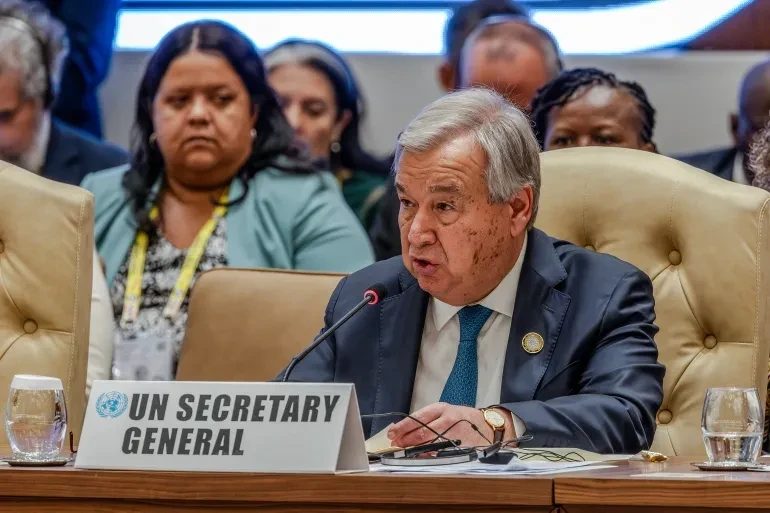
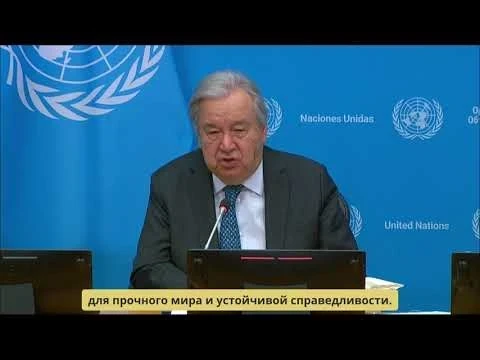
At a press conference in New York, UN Secretary-General António Guterres commented on the current state of international relations, noting that “the law of force prevails over the force of law.” He also shared the main areas of the Organization's work for 2026, which will be his last year as head of the UN.
Period of Uncertainty
Guterres pointed out that 2026 is already being marked as a time of chaos and uncertainty. He emphasized that the world is facing a situation where reckless actions lead to dangerous consequences, exacerbated by geopolitical disagreements and impunity that undermine international stability.
According to him, international law is subject to violations, multilateral institutions are under attack, and impunity is becoming the norm.
“Impunity is the driving force behind modern conflicts, increasing distrust and opening the way for destructive forces,” the Secretary-General noted.
Changes in the World
The Secretary-General highlighted the deteriorating humanitarian situation. He noted that the reduction in humanitarian aid funding is causing a “chain reaction” of despair, migration, and increasing casualties.
Inequality, he said, is deepening, undermining the stability of societies. The climate crisis remains one of the most pressing contemporary issues, and the lack of restrictions on the development of new technologies leads to instability.
Guterres also pointed to outdated mechanisms for addressing global problems, while the world is changing: developing countries are becoming increasingly influential, and trade among them is growing faster than traditional trade between developed countries.
The Importance of Multilateral Institutions
The Secretary-General emphasized that global challenges cannot be resolved by one or two powers seeking to divide the world into spheres of influence. He called for accelerated and purposeful development of a multipolar world based on partnership.
“However, multipolarity alone does not ensure stability. Europe before World War I was also multipolar, but the lack of effective multilateral institutions led to conflicts and war,” he added.
“For a multipolar world to become the foundation for balance, prosperity, and peace, strong multilateral institutions are needed, whose legitimacy will be based on shared values and responsibilities,” Guterres concluded.
UN Priorities for 2026
The Secretary-General noted that the Organization will continue its efforts to achieve a stable and just world.
One of the main tasks in his last year in office will be the reform of the Security Council.
“We are striving to reform and strengthen the Security Council – the only body with the authority to act on issues of peace and security on behalf of all states,” he noted.
Guterres emphasized that achieving peace and stability also requires development, and the UN will continue all possible efforts to implement the Sustainable Development Goals.
Among the priority areas of work for 2026 will also be combating climate change and developing a global governance system for artificial intelligence. He reminded of the establishment of an International Scientific Group on Artificial Intelligence within the UN.
Peace Council for Gaza
In response to a question about the Peace Council established at the initiative of US President Donald Trump, Guterres stated that the primary responsibility for maintaining international peace and security remains with the UN Security Council. This body adopted Resolution 2803, supporting the Comprehensive Plan for ending the conflict in the Gaza Strip, and its implementation is crucial.
The Secretary-General noted that, despite the ceasefire, hostilities in Gaza continue, albeit less intensely. He called for a complete ceasefire and a transition to the second phase of the plan, which includes the withdrawal of Israeli troops, disarmament of armed groups, and creating conditions for realizing the two-state solution.
Guterres added that no other bodies or coalitions can replace the Security Council, as only it has the mandate enshrined in the UN Charter to make binding decisions in the field of peace and security and to authorize the use of force in accordance with international law.
Therefore, according to the head of the UN, reforming the Security Council is of great importance. He noted that often those forces that criticize the UN for its lack of effectiveness are opposed to reforming the Security Council.


