
An archaeological discovery was made in 2018 during the reconstruction of a road on the hillside in the capital of Shanxi Province, but the information was only recently made public.
According to Long Zheng, the head of the Research Institute of the Ancient City of Jinyang at the Taiyuan Institute for the Preservation of Cultural Heritage, the walls of the tomb depict paired figures as well as scenes of everyday life, including women grinding flour and men preparing noodles. These images cover various aspects of life, including women with oranges and men assisting in rice milling.
Researchers believe that the tomb belonged to a man who died in 736 AD at the age of 63 during the Tang Dynasty (618-907 AD). He was buried alongside his wife.
The eight frescoes inside the tomb are executed in the "figures under the tree" style, which was popular at the time and depicts scenes from daily life with intricately rendered trees. These works provide a unique insight into the daily life and duties of people during the Tang Dynasty.
All images, except for one, belong to the Han ethnic group, while one of the drawings features a man with light hair and a beard.
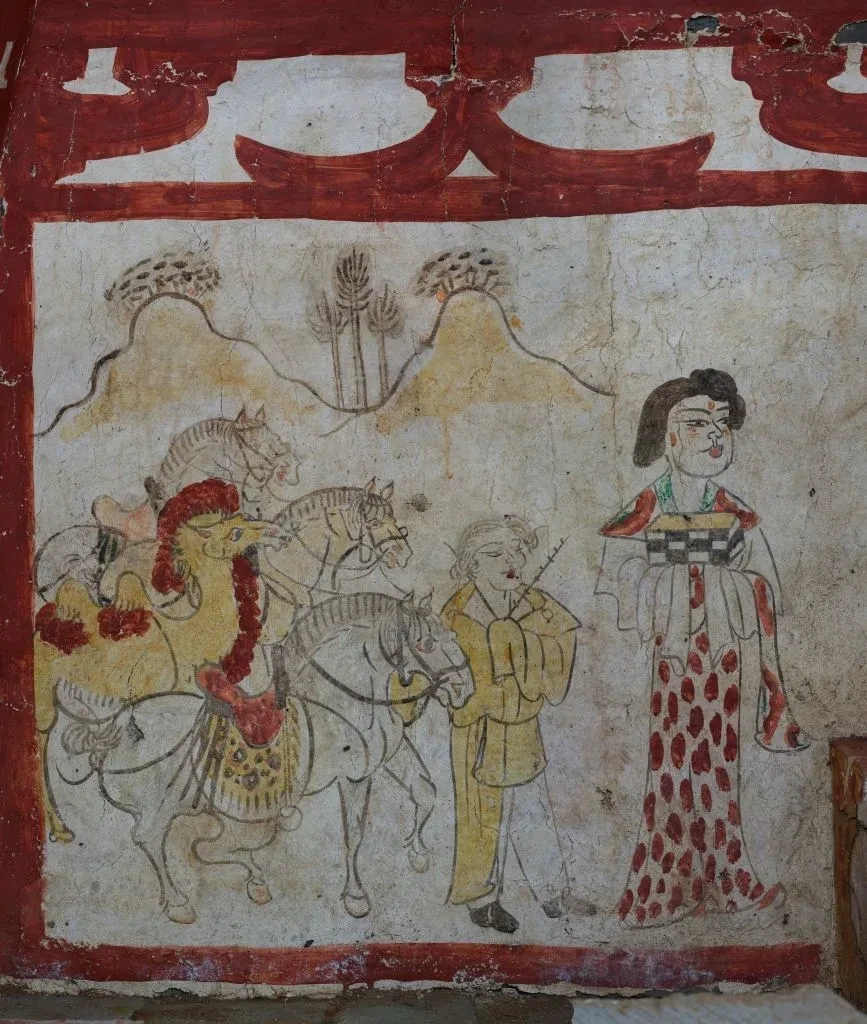
Victor Syun, a history professor at Western Michigan University who was not involved in the excavations, told Live Science that one of the depicted "Westerners" is leading camels, likely from Central Asia. "Judging by his facial features and clothing," noted Syun, "it can be assumed that he is a Sogdian."
Sogdians, a people who lived in present-day Tajikistan and Uzbekistan, played an important role on the trade routes of the Silk Road.
The frescoes cover all the walls of the tomb, except for the floor. According to the South China Morning Post, the style of these images is similar to other frescoes of that time, characterized by clear lines and simple shading.
Zheng noted that the painting style is similar to those found in the tomb of Wang Shenzhi, an important historical figure from the late 800s, during the decline of the Tang Dynasty and the beginning of the Song Dynasty. This may indicate that the works were done by the same artist.
Additionally, paintings were found not only inside the brick tomb but also on the gates, corridor, and pedestal with sarcophagi. The domed ceiling features an image of a dragon, while guards are possibly depicted at the gates in yellow clothing with swords at their waists.
Among other scenes, one can see a woman in a bright outfit leading four horses, with men holding whips nearby; as well as people holding boxes or ritual bowls. The image of an old man, who appears in several scenes, includes actions related to a snake, an axe, and firewood, as well as a bowl. The frescoes abound with images of trees, flowers, mountains, and livestock, and most figures likely represent the same two individuals, suggesting they were the owners of the tomb.
The themes in the frescoes reflect "previously unseen" aspects of domestic life during the Tang era, as noted by Syun in an interview with Live Science. Since the images likely belong to the tomb's owners, they may represent the minutiae of their daily lives. However, the presence of a Western individual adds an intriguing element of mystery to the lives of these long-gone men and women.


