
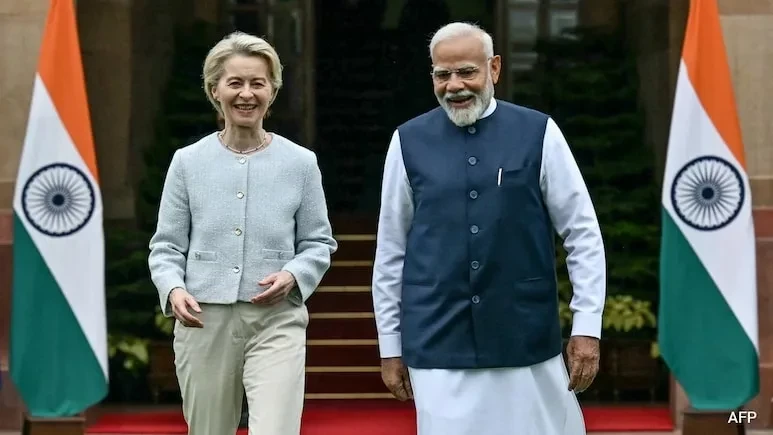
A few days before the summit, the EU's High Representative for Foreign Affairs and Security Policy, Kaja Kallas, emphasized the importance of the upcoming meeting in her speech to the European Parliament, characterizing it as a "reset" of relations between the two strategic partners.
Kallas noted that India is becoming "indispensable" for Europe's economic stability and expressed the EU's readiness to implement a new agenda that will cover areas such as trade, security, technology, and humanitarian ties. These statements were made against the backdrop of active preparations for the summit, where specific decisions on important issues are expected to be made.
In her speech, Kallas referred to the summit as a "turning point," highlighting that the EU and India are coming closer together in the face of global challenges such as wars and economic fragmentation. She urged both sides to uphold international law and a multilateral system that meets the challenges of the 21st century, stating, "The two largest democracies cannot afford to waver."
On the agenda of the summit is the adoption of a new joint EU-India strategy that will define the directions of partnership until 2030. Kallas stated that the leaders would not limit themselves to declarations but would approve concrete steps for the implementation of the planned initiatives.
Three key initiatives are highlighted. The first is the completion of negotiations on a Free Trade Agreement, which aims to open markets, eliminate barriers, and strengthen supply chains in strategically important sectors such as clean technologies, pharmaceuticals, and semiconductors.
Secondly, on Wednesday, the EU announced its intention to sign a new Security and Defense Partnership with India, which Kallas hopes will be signed in New Delhi next week. This agreement will expand cooperation in maritime security, counter-terrorism, and cyber defense, as well as pave the way for negotiations on information protection. "In a more dangerous world, we will both benefit from closer interaction," she emphasized.
The third initiative concerns a memorandum of understanding that will create a framework for cooperation in the field of mobility, simplifying the movement of students, researchers, and highly skilled professionals, as well as enhancing collaboration in research and innovation.
Kallas highlighted the economic significance of the partnership, noting that the EU is one of India's largest trading partners, while India is becoming an important element of Europe's economic resilience. The partnership in clean energy and climate links climate ambitions with industrial competitiveness, covering cooperation in renewable energy and sustainable production.
In the fields of technology and defense, the EU-India Trade and Technology Council is working on cooperation in artificial intelligence, semiconductors, and cybersecurity. Kallas noted that the strategic goal is to create reliable standards that shape global markets.
She also emphasized the importance of the Indo-Pacific dimension of the partnership, pointing to the potential for jointly strengthening stability through the protection of open sea routes and countering coercion.
Recognizing the complexities involved in negotiating the joint statement and the new strategy, Kallas noted that despite the difficulties, work continues and cooperation with Indian partners remains productive, resulting from a shared understanding of the need to achieve concrete results in a dynamically changing geopolitical environment.
As New Delhi prepares for the meeting with the EU's top leadership, Brussels' message about relations with India is becoming increasingly significant — India is emerging as a key player in strategic, economic, and defense matters for Europe.


