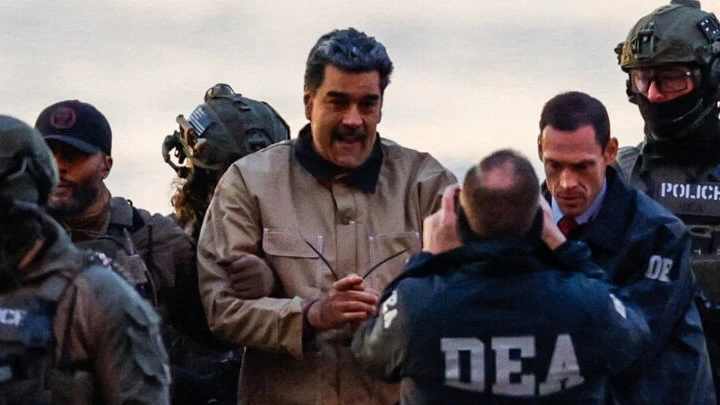
After Donald Trump announced a military operation in Venezuela on January 3, numerous fake images and videos appeared on social media, quickly going viral. Many of them garnered millions of views on platforms like TikTok, Instagram, and X, and were actively shared by various public figures, including Trump and Elon Musk.
Some experts noted that this could be one of the first instances where news videos were created by artificial intelligence in real-time as events unfolded. Other analysts argue that the uniqueness of this phenomenon lies not in its scale, but in the fact that many well-known personalities were misled.
Where is the real Maduro?
During a lightning-fast operation, American special forces captured Nicolás Maduro and his wife. He has been charged with drug trafficking, but he denies his guilt.
After the capture, photos of Maduro began to appear on social media. The Euronews fact-checking team, The Cube, identified numerous examples of fake images that were circulated in various languages, including Spanish, Italian, French, and Polish.
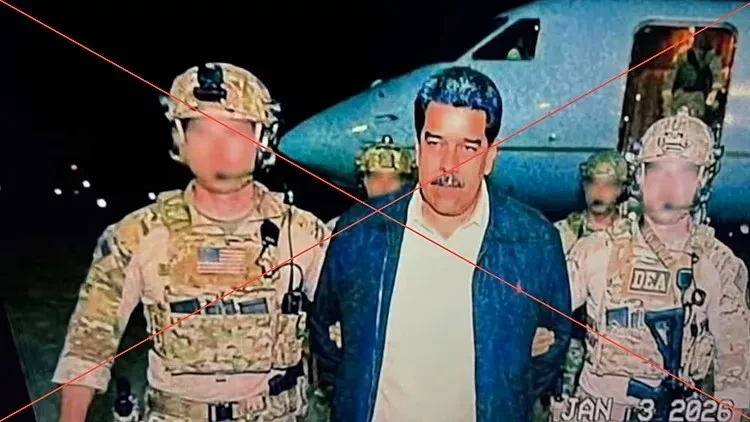
One such image, showing Maduro exiting an airplane, was published by the official account of the Portuguese far-right party Chega and its founder André Ventura. Many news outlets also presented this image as authentic.
Using Gemini's SynthID tool, experts checked this image and found watermarks indicating that it was created or altered using artificial intelligence.
This image received millions of views; the Spanish-language post on X alone had 2.6 million views.
Analyst Tal Hagin noted that the rapid development of AI technologies complicates the detection of fakes. After Maduro's capture, there was very little information available, and people began uploading generated images showing his arrest.
In one of the photos, which received over 4.6 million views, Maduro is depicted in a military aircraft while in custody.
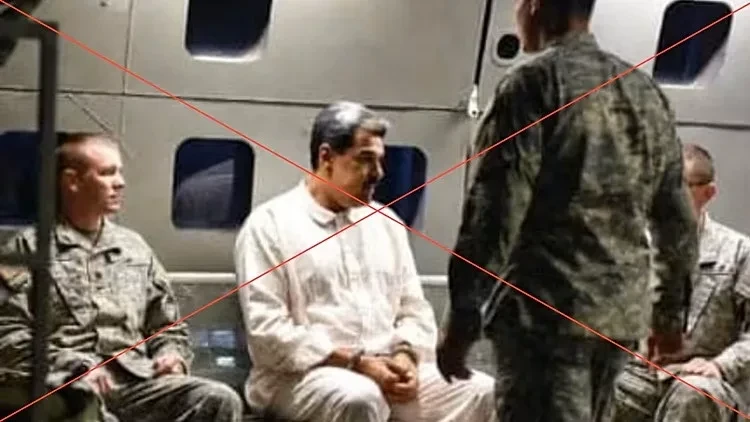
The Newsguard platform, which verifies information authenticity, also confirmed that this image contains clear signs of artificial manipulation and contradicts the facts, as Maduro was flown out of the country by helicopter.
Shortly after the fake images of Maduro's arrest appeared, videos of cheering Venezuelans began to circulate on social media.
Some of these videos garnered over 5.6 million views, but they also showed signs of AI, such as unnatural movements and incorrect details.
According to reports from Venezuela, public opinion remains divided: some residents rejoice at Maduro's overthrow, while others condemn U.S. intervention.
Videos edited from old footage began to appear on social media. One of them collected over a million views on the X platform with the caption "This is Caracas today. The crowds supporting Maduro are huge," although in reality, it is an old video clip from a march that took place in November 2025.
In another popular video circulated in the French-speaking segment of X, a man on a balcony films a crowd with fireworks. "I have rarely seen such a happy people as the Venezuelans, who have finally rid themselves of Maduro thanks to American intervention," reads the caption.
Was there a strike?
In addition to the false images of Maduro, fakes began to spread online claiming that the U.S. struck the mausoleum of Hugo Chávez, which was reposted by Colombian President Gustavo Petro among others.
One of the images claims that the mausoleum was bombed.
[media=https://twitter.com/talhagin/status/2008182438992789759?ref_src=twsrc%5Etfw]
[media=https://twitter.com/Mrgunsngear/status/2007932768433455491?ref_src=twsrc%5Etfw]
However, Hagin emphasizes that the photo on the right is clearly an AI-generated image modeled on a real photo of the mausoleum from 2013, to which destruction elements have been added.
The Hugo Chávez Foundation published a video on Instagram on Monday showing the building looking completely intact.