
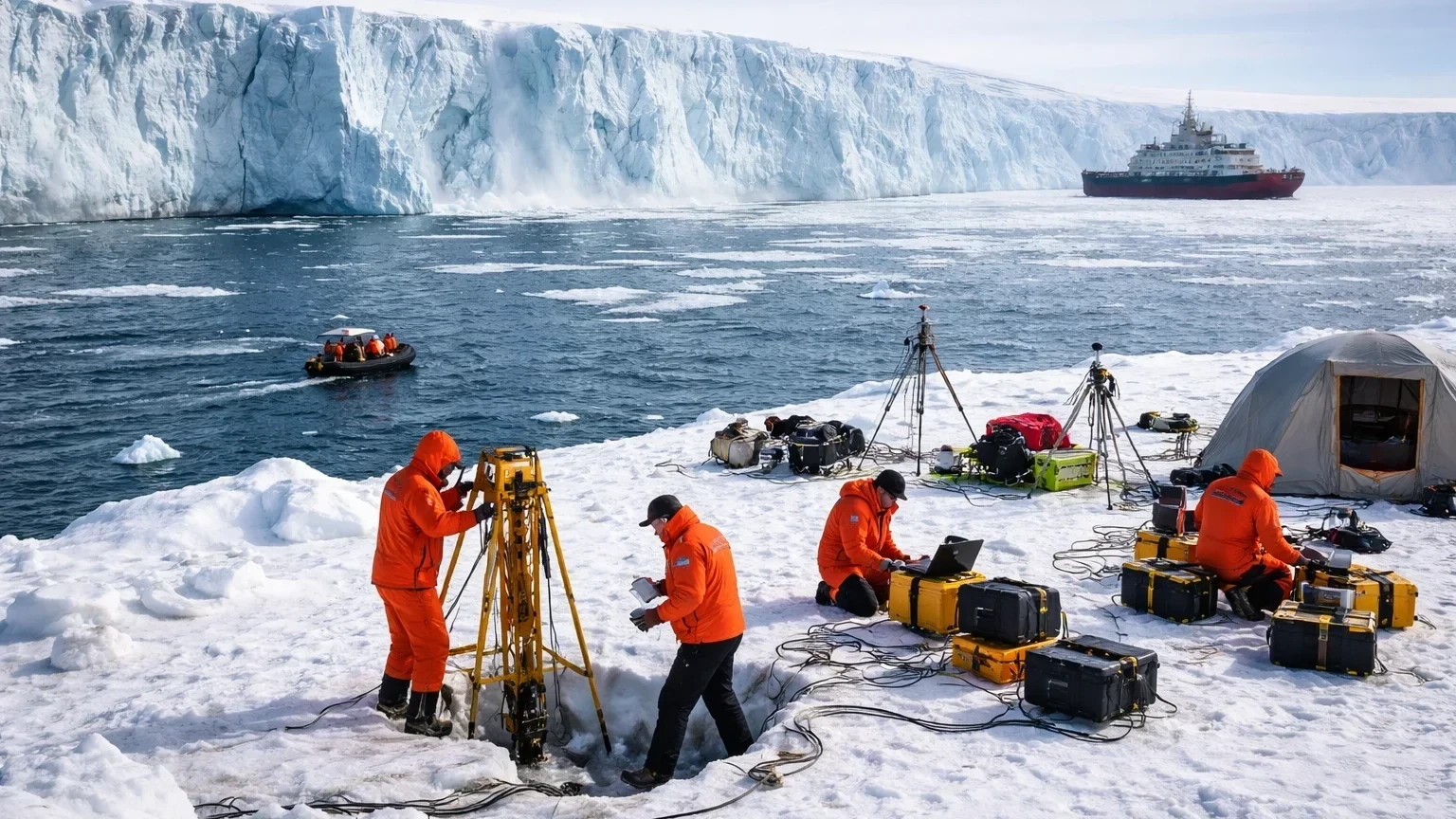
The scientific expedition is actively studying the possible consequences of this event.
The Thwaites Glacier, considered one of the most threatening in global geography, has begun to move, as recorded by scientists. Experts warn that its complete melting could lead to a rise in sea level of at least 60 centimeters, and in the worst-case scenario, by 3 to 5 meters.
This development could trigger a chain reaction affecting other glaciers. Satellite data indicate that warm ocean waters are eroding the base of Thwaites, causing cracks and cavities to form.
Currently, an international scientific mission is underway in Antarctica to study the glacier, which aims to help assess its condition.
Reasons for the danger of Thwaites Glacier
Thwaites is located in West Antarctica and covers an area of about 192,000 square kilometers. It acts as a "gatekeeper," holding back ice masses, and its loss could have serious consequences for the entire region.
If this glacier melts, sea level will rise by at least 60 cm, and in the worst case, by 3 to 5 m, which would threaten the lives of millions of people and negatively impact the economies of coastal states.
Worrying data on glacier destruction
It was previously thought that Thwaites was stable due to its position on the seabed. However, recent satellite and hydrological studies have shown that warm currents are penetrating under the ice, causing its destruction.
Experts now believe that the threats posed by global warming are significantly underestimated, and the actual rate of glacier destruction may exceed current forecasts.
Lessons from the past: what climate history tells us
Paleoclimatic studies show that similar glacier collapses occurred on Earth about 120,000 years ago, when sea levels rose sharply. Analyzing these events will help understand how the current situation may develop.
If the scenario repeats, the consequences could manifest much sooner than conservative models suggest.
Progress of the expedition
The expedition, which started from New Zealand on the South Korean icebreaker "Aaron," includes about 40 participants, including scientists and journalists. Work at the glacier's edge will last about a month.
Working conditions are extremely challenging: the glacier moves at speeds of up to nine meters per day, posing risks to equipment. Extremely low temperatures and strong winds also complicate the processes.
Innovative technologies and research methods
Modern technologies are being used to study the glacier, such as airborne radar scanning and drilling to depths of up to 800 meters to install sensors. Additional equipment is dropped from helicopters into hard-to-reach areas.
One interesting solution has been the use of seals, to which miniature sensors are attached to measure temperature and salinity of water at depths of up to 500 meters. This data is transmitted via satellite, providing researchers with unique information from inaccessible areas.
Global significance of the research
The results of the research will help refine models of sea level rise and create more accurate forecasts for centuries to come. This data is crucial for strategic planning at a global level—from developing protective systems to revising insurance standards and infrastructure.
The future of millions of people living in coastal areas depends on understanding the stability of Thwaites Glacier. The answers that scientists obtain during the expedition could prove decisive in the fight against climate change.


