
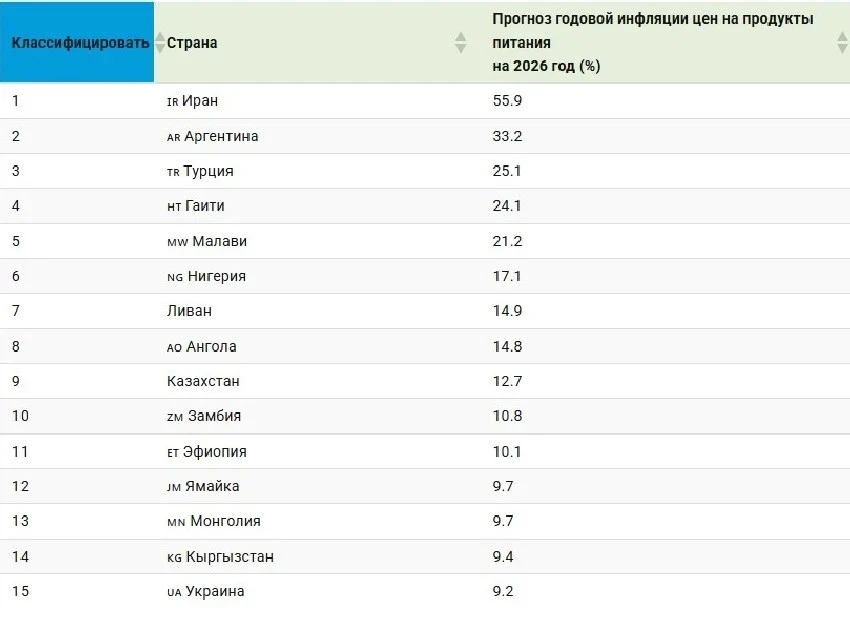
Forecasts suggest that next year the Kyrgyz Republic will face serious inflationary pressure, ranking 14th in the world in terms of food price growth.
Indicators for Kyrgyzstan and the Region
In 2026, food inflation in Kyrgyzstan is expected to reach 9.4 percent, significantly exceeding the global average inflation rate, which is projected at 3.2 percent.
Kazakhstan, a neighboring country, ranks 9th in the world with a forecasted price increase of 12.7 percent. Overall, in the Europe and Central Asia region, the average inflation rate is expected to be 4.2 percent, making Kyrgyzstan's figures among the highest in the macro-region.
Global Context
The leaders in critical price growth are:
- Iran — 55.9 percent;
- Argentina — 33.2 percent;
- Turkey — 25.1 percent.
At the same time, in the USA, the price increase will be only 2.7 percent, and in Canada — 4.3 percent. The lowest figures are expected in the Asia-Pacific region, where prices will rise by only 1 percent.
Factors and Risks
According to FAO experts, food prices in developing countries are influenced by fluctuations in exchange rates, dependence on imports, and disruptions in supply chains. High food inflation creates an additional financial burden for households, as food expenses remain a primary cost for most people.
Despite the slowdown in global inflation, the situation in the 160 studied countries remains diverse. For millions of people in countries with high food vulnerability, including Kyrgyzstan, the challenging situation will persist into 2026.
As of the end of 2025, inflation in Kyrgyzstan was 9.4 percent, exceeding the National Bank of the country's target corridor of 5-7 percent. Since the beginning of 2026, as of February 16, inflation has already reached 1.8 percent (year-on-year — 9.6 percent). The measures taken by the government have yet to yield tangible results.
According to the latest forecasts from international financial organizations, inflation in Kyrgyzstan in 2026 may be:


