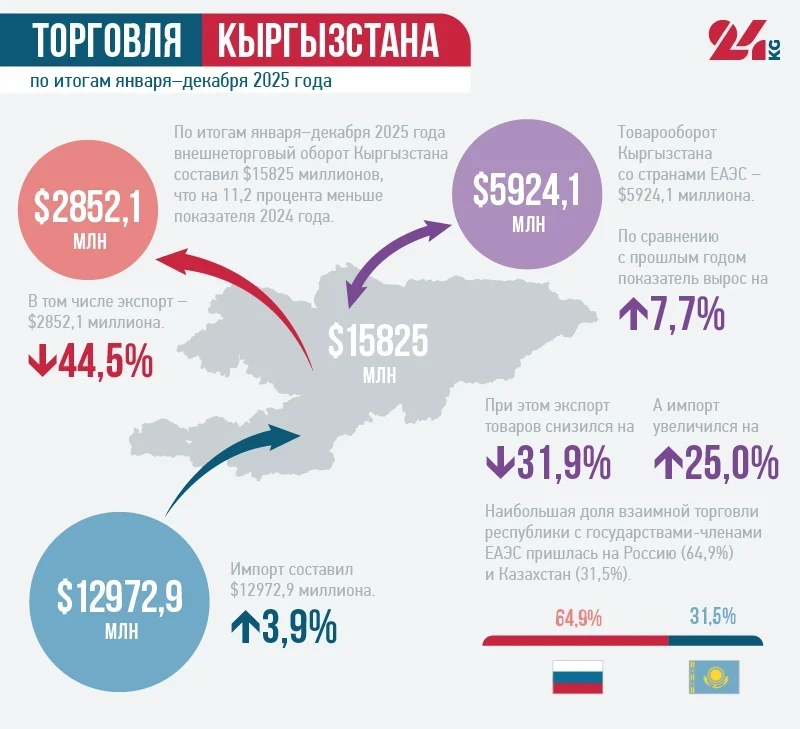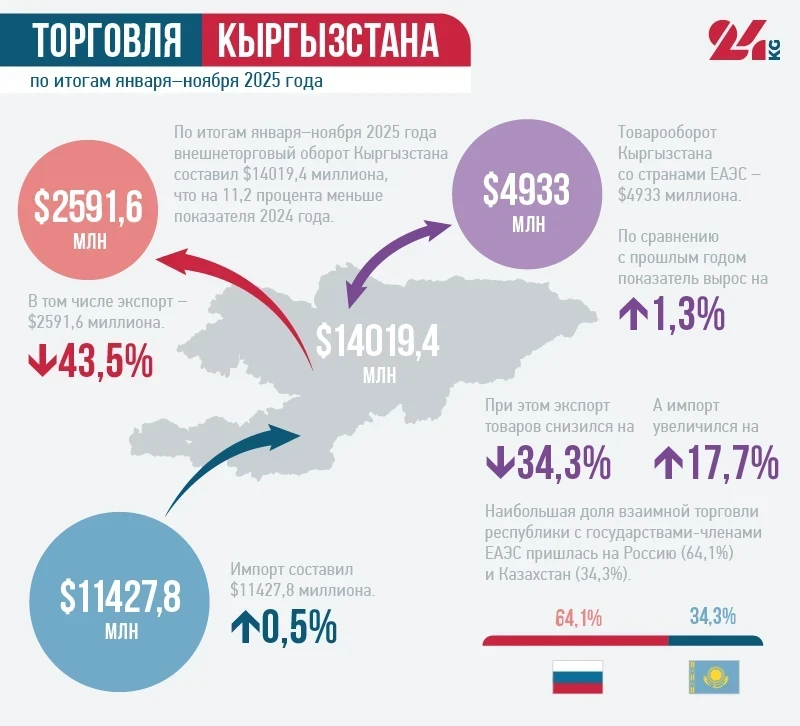
According to data from the National Statistical Committee, the total volume of Kyrgyzstan's foreign trade in 2025 amounted to $15 billion 825 million, which is a decrease of 11.2% compared to 2024.
Decrease in Exports
The main factor contributing to the negative dynamics was a sharp reduction in export volumes, which fell by 44.5%. In 2025, they amounted to only $2 billion 852.1 million.
Imports to Kyrgyzstan, on the other hand, increased by 3.5%, reaching $12 billion 972.9 million.
Kyrgyzstan remains heavily dependent on imports, which account for over 81% of the country's total trade turnover.
Factors Contributing to the Decline in Exports
Throughout 2025, the government of Kyrgyzstan imposed several bans on the export of various goods, such as scrap metal and livestock. There were also restrictions on the import of certain goods into the country, which had a direct impact on the volume of foreign trade, especially in the export sector.
According to the National Statistical Committee, in 2025, the most significant decline in export supplies compared to 2024 was observed in the following categories:
- live animals - a decrease of 5 times;
- footwear - a decrease of 4 times;
- gold - a decrease of 3.7 times;
- waste and copper scrap - a decrease of 2.4 times;
- textile clothing - a decrease of 25.4%;
- vegetables and root crops - a decrease of 22.2%;
- ferrous metals - a decrease of 20%.
Since the beginning of 2026, the government has already imposed a ban on the export of waste paper and cardboard, which will be in effect for six months. Restrictions on the export of scrap and waste of ferrous metals have also been extended.
Despite the overall decline in exports, in 2025 there was an increase in supplies in the following categories:
- ores and concentrates of precious metals - an increase of 2 times;
- plastics and products made from them - an increase of 28.3%;
- lignite (brown coal) - an increase of 17.3%;
- ceramic products - an increase of 14.8%;
- coal - an increase of 6.6%.
Imports: What Increased
In 2025, imports significantly increased:
- bread and flour confectionery - an increase of 3.2 times;
- products made from ferrous metals - an increase of 1.7 times;
- ferrous metals - an increase of 1.6 times;
- wood and products made from it - an increase of 1.6 times;
- water, including mineral and carbonated with sugar - an increase of 1.5 times;
- measuring and control instruments and devices - an increase of 43.8%;
- rubber and products made from it - an increase of 40.1%;
- various food products - an increase of 31.2%;
- plastics and products made from them - an increase of 30.7%;
- natural and liquefied gas - an increase of 18.3%;
- oil products - an increase of 16.7%.
At the same time, the volumes of purchases of other goods significantly decreased:
- knitted fabrics - a decrease of 1.8 times;
- equipment and mechanical devices - a decrease of 29.8%;
- clothing and clothing accessories - a decrease of 27.7%;
- land transport means and their parts - a decrease of 17.8%;
- chemical fibers - a decrease of 15.8%.
Trade with the EAEU
In 2025, trade turnover with EAEU countries amounted to $5 billion 924.1 million, which is 7.7% more compared to 2024. However, there is also an imbalance here:
The largest share of mutual trade was with Russia (64.9%) and Kazakhstan (31.5%).