
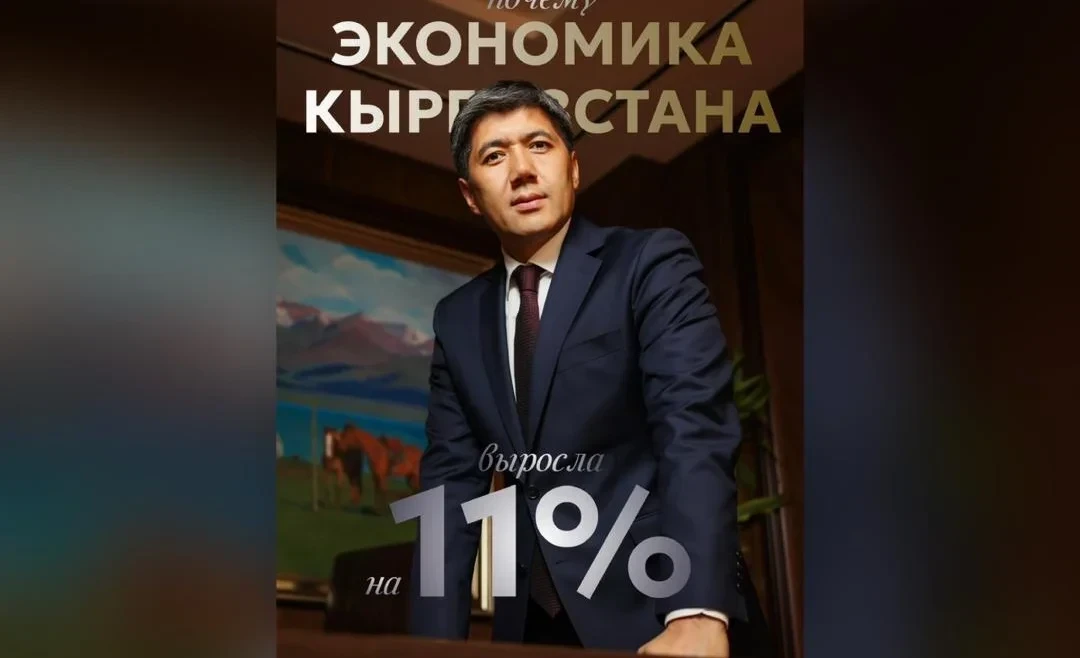
In 2025, Kyrgyzstan's economy, according to preliminary data, demonstrated a growth of 11.1%, placing the country among the leaders in this indicator on a global scale. Melis Turgunbaev, the chairman of the National Bank, shared his views on the factors contributing to such accelerated development, as well as the specifics of small open economies in the context of global instability.
He emphasized that in previous years, the economy also showed impressive results: in 2023, growth was 9%, and in 2024, according to revised data from the National Statistics Committee, it was 11.5%.
According to Turgunbaev, Kyrgyzstan belongs to small open economies that experience significant influence from external trade and international financial flows. The impact of fluctuations in global markets, whether it be rising prices for oil or food, as well as disruptions in logistics, immediately affects inflation, the exchange rate of the national currency, and the pace of economic growth.
"Small economies are particularly vulnerable to external shocks. If fuel or grain prices rise on the global market, it is immediately felt in the country," he noted.
Turgunbaev explained that Kyrgyzstan is generally a price taker. The republic imports a significant amount of fuel, wheat, and other essential goods, and has no ability to influence their prices. Moreover, the limited domestic market does not provide much resilience compared to larger economies.
Additionally, according to the head of the National Bank, Kyrgyzstan is vulnerable due to the high concentration of external trade. Russia, Kazakhstan, and China are the main trading partners, accounting for about half of exports and almost two-thirds of imports.
However, global instability also opens up new opportunities. Turgunbaev noted that changes in trade routes and logistics as a result of sanctions pressure on Russia have led to a redistribution of business flows in the region. This, in turn, has contributed to the development of logistics, warehouse infrastructure, transit operations, and the financial sector in Kyrgyzstan, which has become one of the factors of accelerated growth.
The head of the National Bank highlighted three main areas that help small open economies mitigate the impact of external shocks.
The first is economic diversification. The development of processing, industry, the agricultural sector, and tourism, as well as the expansion of sales markets and energy sources within the National Development Strategy until 2030, helps reduce dependence on external factors.
The second area is macroeconomic discipline. As of the end of November 2025, the ratio of public debt to GDP was 43.49%, which provides some room for maneuver. It is important to use this reserve rationally, increasing reserves, controlling the budget deficit, and ensuring price stability.
The third area is the quality of institutions. Melis Turgunbaev noted that the long-term sustainability of the economy depends on effective governance, transparent business rules, a stable banking system, protection of property rights, and the independence of regulators, which in turn increases trust and reduces social risks in times of crisis.


