
Factors Driving Price Increases
Vendors noted that the increase in meat prices was due to its export to neighboring countries such as Uzbekistan and Tajikistan, as well as rising feed prices and production costs.Bakytbek Mamytkanov, chairman of the Association of Meat Producers of Kyrgyzstan, reported that meat prices, especially beef, are rising globally, as confirmed by the World Bank. According to him, Kyrgyzstan's neighbors, such as Uzbekistan and Tajikistan, are also experiencing a meat shortage. Previously, it was difficult to illegally export livestock, but now it has become possible. In Kazakhstan, meat prices also significantly increased last year, and in Turkey, the price per kilogram reaches 1,800 soms when converted to Kyrgyz currency," he added.
The key reason for the rising meat prices, according to Mamytkanov, is the poor quality of foot-and-mouth disease vaccines that are coming into Kyrgyzstan, leading to weight loss in livestock.
“In the last month, there has been an outbreak of foot-and-mouth disease among cattle. Previously, there was a problem with dermatitis. Meat prices dropped last week as farmers are slaughtering their livestock to avoid infection,” he said.
According to Mamytkanov, this situation also occurred last year. A new increase in meat prices is expected by spring and summer. “Two years ago, there was no such problem. The young stock that will be born this year will not have time to grow. Farmers will be slaughtering the existing livestock, fearing bankruptcy,” he explained.
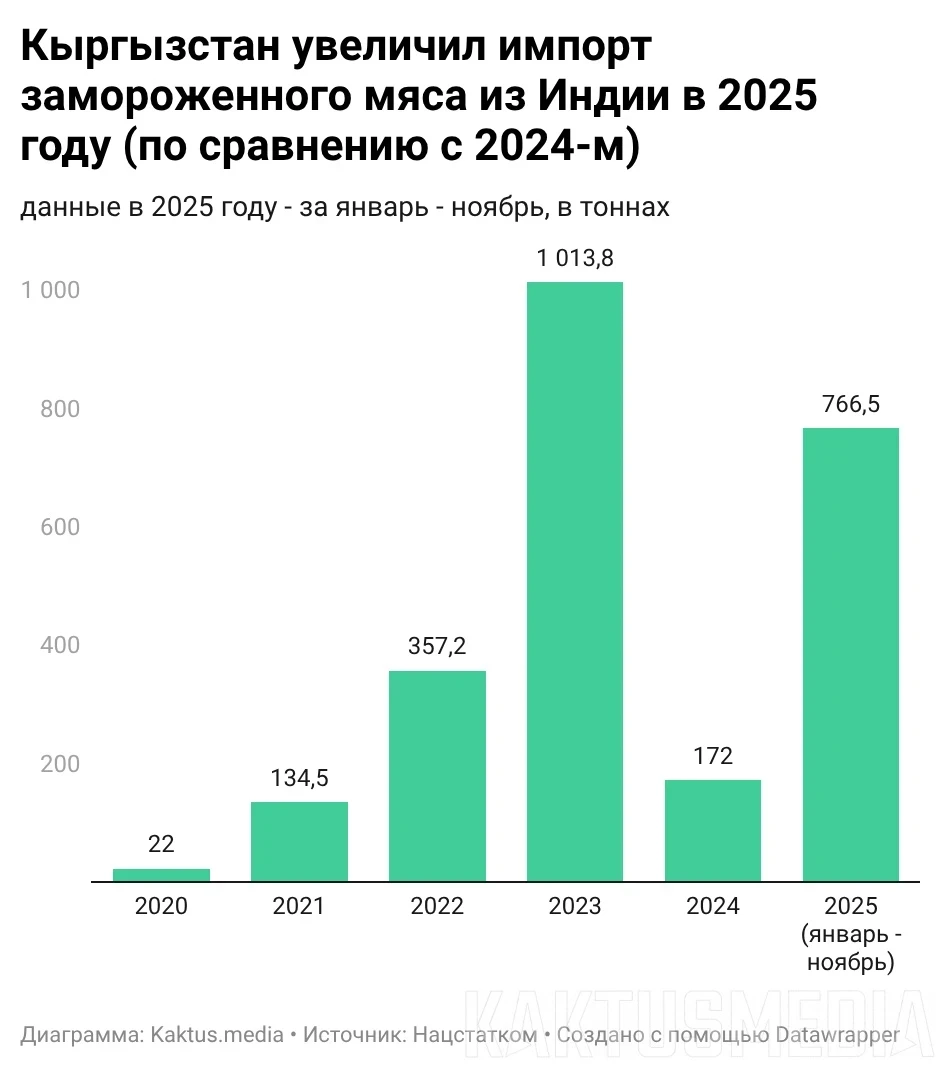
Against the backdrop of rising prices, Kyrgyzstan has started importing larger volumes of beef from abroad, mainly from India, where there is currently an outbreak of the Nipah virus, which can be transmitted from agricultural animals.
alt="Meat prices in Kyrgyzstan: what has changed since last year?"
/>
According to the latest data, from January to November 2025, Kyrgyzstan imported 1,200 tons of frozen beef worth $3.9 million, with 63% of the imports coming from India.
It is important to note that the Ministry of Water Resources and Agriculture has reported that they have already restricted the import of animals susceptible to the Nipah virus, as well as animal products from India.
Mamytkanov added that the majority of imported frozen beef is used by processing enterprises. “This is necessary for the production of dumplings and sausages, as it is cheaper,” he clarified.
Solutions: Support or Restrictions?
Mamytkanov believes that Kyrgyzstan has good conditions for developing livestock farming and increasing meat production. Currently, the authorities are providing preferential loans for the purchase of livestock.“Thus, a farmer who receives funding will be able to raise livestock in one to two years and start repaying the loan only after two years,” he explained.
However, Mamytkanov is convinced that the ban on meat exports is not the right solution, as higher export prices will stimulate domestic production. When asked whether it would be more profitable for farmers to sell their products abroad, he replied that the authorities should negotiate with livestock breeders to ensure that 50% of the products remain on the local market at reduced prices.
Work in this direction is already underway. The state-owned enterprise “Kyrgyz Agroholding,” under the Ministry of Water Resources, Agriculture, and Processing Industry of the Kyrgyz Republic, has conducted a presentation of a project for mobile meat sales points at social prices, which should help stabilize the domestic market. Nevertheless, the question of whether the authorities will be able to provide farmers with quality vaccines and control meat prices in 2025 remains open.
Photo on the main page: EPA / TASS.


