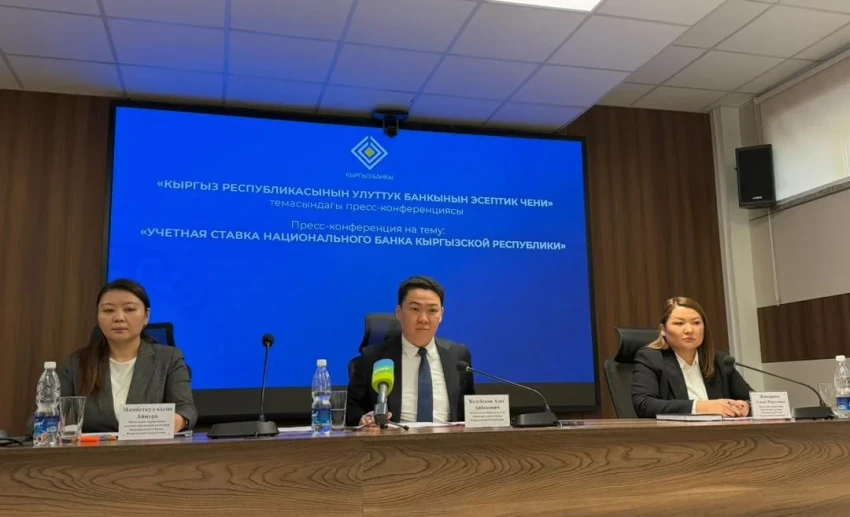
Today, at a briefing, representatives of the National Bank of Kyrgyzstan announced the maintenance of the discount rate at 11 percent.
The National Bank noted that "the country's economy is demonstrating stable growth, with real GDP increasing by 11.1 percent by the end of 2025."
“The main factors contributing to economic growth are the construction sector and services. Investment activity in the republic remains high, primarily due to increased budget financing,” the NBK stated in its announcement.
The growth of real incomes of the population, the inflow of remittances, and active consumer lending support consumer demand.
The National Bank
“As of January 16, 2026, inflation in the Kyrgyz Republic was 9.4 percent year-on-year (for the end of 2025 — 9.4 percent). Price trends are in line with the expectations of the National Bank, with some slowdown in the growth of food prices,” the financial regulator's document reports.
According to their data, “in the category of non-food goods and in the services sector, prices remain high due to secondary effects of external factors. Annual revisions of tariff policy and increased domestic demand also influence inflation.”
Reference 24.kg
The discount rate is the main tool of the central bank's monetary policy, determining the cost of short-term loans for commercial banks. This, in turn, affects the overall cost of loans in the country and the lending conditions for the population and businesses.
“The main task of the National Bank's monetary policy remains to reduce inflation to the target value of 5-7 percent in the medium term, which necessitates maintaining sufficiently tight monetary conditions,” the bank noted.
Tactical measures are aimed at limiting the monetary impact on inflation: in conditions of high liquidity in the banking sector, the National Bank actively conducts sterilization operations, regulating the money supply in the economy. In these conditions, the interbank benchmark interest rate BIR is formed around the lower boundary of the National Bank's interest corridor, the regulator reported.
The domestic currency market remains stable.
The National Bank
“Inflation continues to be influenced by external factors. Global food and commodity markets remain highly volatile, and geopolitical instability contributes to the persistence of inflationary risks in various countries, including key trading partners of Kyrgyzstan, which affects import prices,” the NBK explained.
According to the National Bank, “inflationary processes in the country are largely determined by non-monetary factors, such as planned changes in regulated tariffs and increased domestic demand.”
These circumstances require maintaining current monetary conditions until stable prerequisites for reducing inflation are established.
The National Bank
“The National Bank adheres to a balanced approach in monetary policy and continues to analyze both external and internal factors affecting inflation. In the event of risks to price stability, it does not rule out the possibility of adjusting the monetary policy being implemented,” representatives of the financial regulator emphasized.
The next meeting of the NBK Board regarding the discount rate is scheduled for February 23.